
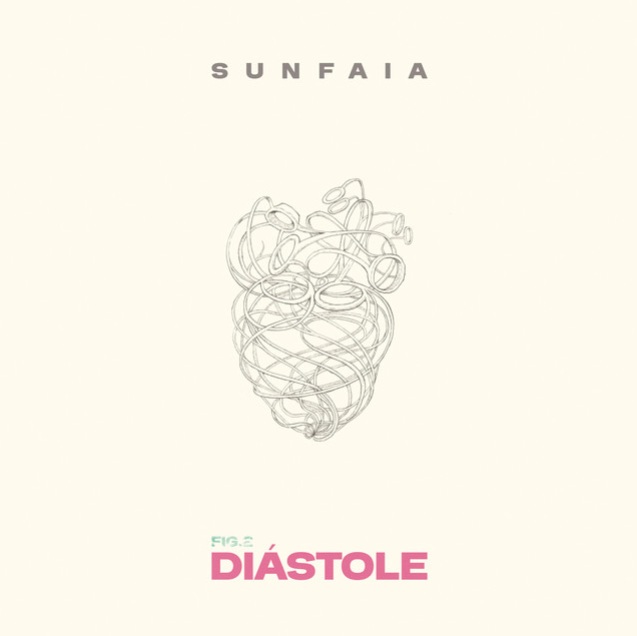
Desde Madrid, Sunfaia cierran el círculo que abrieron con Systole (2022) con este nuevo EP, Diástole (2026). Dos mitades de un mismo latido. Expansión. Presión.
En teoría todo encaja.
En la práctica, no es tan limpio.
Based in Madrid, Sunfaia close the conceptual circle they opened with Systole (2022) with their new EP, Diástole (2026). Two halves of a heartbeat. Contraction and expansion. Pressure and release. It sounds neat on paper.
It doesn’t feel neat when you listen to it.
Si me lees a menudo, sabes que no suelo entrar en las letras en la primera escucha. Yo voy a lo físico: al pulso, a la tensión, al riff que te descoloca el estómago o te eriza el vello de la nuca. Las palabras vienen después (o simplemente nunca vienen). Primero necesito sentir algo.
Con Diástole no hubo margen para eso.
If you’ve read me before, you know I don’t usually obsess over lyrics, especially on the first spin. I go for tone, tension, rhythm, the way a riff makes my stomach flip or my hair stand on end. Words come later, or never. I need to feel something before I analyze it.
With Diástole, I didn’t have that luxury.
“Amar & Desobedecer” (publicada hace un año) arranca suspendida, casi misteriosa. Y de repente… boom. Entra el beat y estoy en un coche en 1995 con “California Love” sonando por unos altavoces reventados. Sí, ya lo sé. La comparación parece una locura. Un momento… No estoy diciendo que Sunfaia suenen a 2Pac y Dr. Dre. Estoy diciendo que esa seguridad rítmica, esa inevitabilidad física que te obliga a mover el cuello aunque no quieras, está ahí. Y eso no es algo que no se encuentra todos los días en una banda de rock de Madrid.
Y eso son solo los primeros treinta segundos del EP.
“Amar & Desobedecer” (released a year ago!) opens in this suspended, almost mysterious space. And then… boom! That beat drops and suddenly I’m in a car back in 1995 with “California Love” blasting through blown-out speakers. Yeah, I know… The comparison sounds unhinged. Stay with me. I’m not saying Sunfaia sound like 2Pac and Dr. Dre. I’m saying that rhythmic confidence, and the physical neck-aching inevitability is there. Not something you typically hear from a rock band from Madrid.
And that’s just the first thirty seconds of the EP.
El tema cambia. Y mi atención también: del sonido a la letra. Aquí no están para rellenar. No están para sonar bonitas. “Un soldado no acató la orden, otro ni se puso el uniforme.” Eso no es una frase resultona. Es el núcleo. La negativa como acción. El amor como desobediencia. El “no” convertido en la palabra más heroica del idioma.
Y, de repente, estoy pendiente de cada palabra.
The track morphs, as did my attention from the sound to the lyrics. They aren’t just decorative here. They don’t just sound good phonetically. They’re structural. “Un soldado no acató la orden, otro ni se puso el uniforme” (One soldier didn’t obey the orders, another one wouldn’t put on the uniform). That’s not just a cool line. That’s the thesis. Refusal as action. Love as rebellion. “No” becoming the most heroic word in the language.
And suddenly I’m paying attention to every word.
La primera vez que escuché “Dulce Mentira” pensé, sinceramente: “Vale. Sólida. Hard rock con balanceo reggae que conecta con su material anterior” (The Secret Combustion, 2012). No había nada mal. Pero tampoco nada que me volara la cabeza.
Hasta el minuto 2:30.
Tuve que ponerme el segundo auricular y subir el volumen. Ese lamento tipo sirena (todavía no sé si es un pedal de sinte o teclas, aunque Hammond hay, eso seguro) cambia el sentido de todo. Y cuando entra bajo “Los besos son la dulce miel… que crea mi adicción”, el tema deja de ser otro corte sólido de hard rock y se convierte en confesión.
Ahí es donde Diástole se vuelve peligroso.
The first time I heard “Dulce Mentira,” I honestly thought, “Okay. Solid. Hard rock with a reggae swing that nods back to their earlier material” (in this case, their 2012 EP The Secret Combustion). There was nothing wrong with it. But nothing earth-shattering either.
Until minute 2:30.
I literally had to put my second earbud in and turn the volume up. That siren-like wail (I still don’t know if it’s a synth pedal or keys since there’s definitely Hammond lurking in there) reframes the entire song. And when it hits under “Los besos son la dulce miel… que crea mi adicción” (your kisses are addictive like sweet honey and make me beg for more) the track stops being just another hard rock cut and becomes confession.
And this is where Diástole becomes dangerous.
Sunfaia hablan de “latidos perturbados que buscan aire, la contradicción entre producción y pasión, entre sistema y carne viva”. A mí me gusta cuestionar las cosas. Pero tampoco voy a discutir con los que han escrito las canciones.
Eso sí, añado algo: para mí, esto son canciones de amor. Vamos a ver: hay un corazón humano en la portada. Literal.
No hablo de canciones de amor tipo Whitesnake o Ed Sheeran. Hablo de canciones de amor torcidas. Combativas. Apocalípticas. Pero canciones de amor, al fin y al cabo.
Sunfaia describe the EP as full of “Disturbed heartbeats gasping for air, the contradiction between production and passion, between the system and living flesh.” I like to question things. But I’m not going to argue with the guys that came up with the songs…
But I will add this: to me, these are love songs. I mean, there is literally a human heart on the cover. I’m not talking Whitesnake or Ed Sheeran love songs. These are twisted love songs. Combative love songs. Apocalyptic love songs. But love songs, nonetheless.
Come on, there is literally a human heart on the cover.
Piénsatelo bien: la primera construye una épica de la desobediencia heroica. La segunda la desmonta desde dentro. ¿Amar a alguien que sabes que te va a romper? Ahí no pasa nada… Si es por amor. La contradicción no es un descuido. Si todo va a arder, Sunfaia te dicen que es mejor que sea con alguien que arde igual que tú.
Y luego van y lo meten en el mismo título de la tercera pista: “Arderá”. No voy a repetirme; ya escribí bastante cuando salió como single. Pero aquí el fuego no es solo una combustión destructiva; es purificación. El fuego arrasa con el yugo en nuestra nuca, con el miedo y con el dolor emocional. Es quitarse de encima lo que pesa. Eso de “guárdate tu chispa en tu interior” es clave. La chispa no es para quemarte por dentro; es la llama piloto del lanzallamas que algún día apuntarás al mundo.
Think about it: the first song builds a case for heroic disobedience, the second dismantles it. Loving someone you know will wreck you? Apparently that’s allowed. The contradiction isn’t accidental. Love makes it OK: if the world is going to burn, Sunfaia decides to burn in the arms of the one person who burns just as brightly.
And speaking of burning, the next track, “Arderá” (burn), puts that sentiment right in the title. I’m not going to fan girl much more on this song. I already wrote enough about it when the single was released a couple months ago.
This is not just a burning destruction; it’s purification. The fire destroys the external yoke, the internal fear, and the emotional pain. The instruction to “guárdate tu chispa en tu interior” (keep your spark inside) is vital. The spark isn’t for burning from within; it’s the pilot light for the flamethrower you’ll eventually aim at the world.
«Sunfaia publica “Arderá”: rock alternativo que quema por dentro» en Dirty Rock Magazine: https://www.dirtyrock.info/2025/12/sunfaia-publica-ardera-rock-alternativo-en-castellano-que-quema-por-dentro
Después llega la súplica espiritual que es “Ánima Mundi”.
Esta me descolocó más despacio. Vuelve el pulso reggae, más lento, más contenido. La idea Platónica del mundo como un organismo vivo con alma no está puesta como cita culta. La canción es un ruego desesperado, hermoso y doloroso de pedirnos que entendamos algo antes de que los pájaros sean todos de poliespán. “Todavía no entendéis.” Repetido sin dramatismo. Como quien insiste porque ya no sabe cómo explicarlo mejor.
Then comes the spiritual plea that is “Ánima Mundi.”
This one unsettled me more quietly. The reggae pulse returns, slower now, heavier. Plato’s idea of the world as a single living organism with a soul isn’t used as aesthetic garnish. The song is a desperate, beautiful, and heartbreaking attempt to beg us to understand before the birds are all made of styrofoam. “Todavía no entendéis” (you still don’t get it). Repeated. Not dramatized. Just… insisted.
Y por último, “Decibelia”.
Si Diástole fuese simplemente la segunda mitad parte de un díptico, bastaría. Pero es más que eso. Funciona como concepto en sí mismo. “Decibelia” no es solo el cierre: es la piedra Rosetta que descifra todo lo anterior, aunque no ofrezca salida. “Y no hay lugar donde escapar” pesa como una condena permanente. Como este mundo en el que vivimos, donde estamos sometidos a un goteo constante de horrores.
And finally, we reach “Decibelia.”
If Diástole were just the second half of a two-part series, that would be enough. But it’s more than that. It seems like a concept in itself. “Decibelia” is not just the last song. It’s the Rosetta Stone that deciphers all the others. It’s the truth that makes sense of everything, albeit without resolution. “Y no hay lugar donde escapar” (“there’s no escape”) makes it feel like a permanent imprisonment. Just like this world we live in, where we are constantly subjected to horrors.
Al menos queda un atisbo de esperanza: “…sus calles son mis venas”. Somos nuestras ciudades. Nuestras ciudades somos nosotros. Y la única promesa es encontrar a alguien dispuesto a caminar esas calles contigo, sabiendo que son oscuras, sabiendo que las bandas tocan la misma canción cada noche, aun sabiendo que no hay escapatoria.
Quizá no sean canciones de amor después de todo. Quizá sean un testamento de amor.
At least there is hope: “…sus calles son mis venas” (your streets are my veins). We are our cities. Our cities are us. And the only hope is to find someone willing to walk those streets with us, knowing they are dark, knowing the bands play the same song every night, knowing there is no escape.
Maybe they’re not love songs after all. Maybe they’re a love testament.
A esto me refiero cuando digo que se nota pensado. Pensado de verdad. De alguien que se ha sentado con ello.
La acumulación de “micro-negativas” en “Amar y Desobedecer”. La rendición ante un optimismo tóxico en “Dulce Mentira“. La combustión. El lamento planetario. El final claustrofóbico. Hay demasiada coherencia como para que sea casual.
This is what I mean when I say Diástole feels thought-out. In a “someone sat with this” way.
The accumulation of micro-refusals in “Amar & Desobedecer” (To Love & To Disobey). The surrender to toxic optimism en “Dulce Mentira” (Sweet Lie). The combustion. The planetary lament. The claustrophobic finale. It’s too coherent to be accidental.
Y aquí va lo incómodo: yo no quería escribir tanto sobre las letras. Pero no me dejaron alternativa.
Porque Diástole no es solo sólido en lo sonoro (¡porque lo es!). Pero también es hermético en lo conceptual. Los ganchos están ahí. Las armonías, los grooves, los estribillos que se quedan… Pero debajo hay arquitectura. Venas que lo conecta todo.
And here’s the thing: I didn’t want to write about the lyrics this much. But I had to.
Because Diástole isn’t just sonically tight – because it is! But it’s also conceptually airtight. The hooks are there. The harmonies and grooves and repeatable refrains are there. But beneath all that there’s architecture. Veins that connect it all.
He escuchado este EP las suficientes veces para saber que merece volver. Y no lo digo por quedar bien. No vuelvo a poner un disco por compromiso. No suelo insistir cuando no hay nada que rascar.
Aquí lo hay.
No es música protesta. No es optimismo barato. No es rebeldía vacía.
Es un latido bajo presión.
Si lo escuchas de verdad y no de fondo, puede que empieces a oírlo tú también.
I’ve listened to this EP enough times now to know that it rewards digging. And I don’t say that lightly. I don’t re-spin things out of obligation. I do it when there’s something there.
There’s something here.
Not protest music. Not naïve hope. Not empty rebellion.
A heartbeat under pressure.
And if you’re willing to actually listen and not just play it in the background, you might start noticing it too.
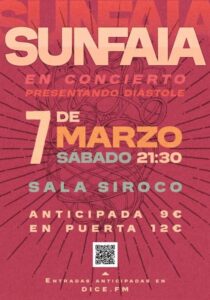
Sunfaia tocan este sábado, 7 de marzo, en la Sala Siroco de Madrid (y tienen más fechas en camino).
Yo no me lo perdería.
SUNFAIA will be playing at Madrid’s Siroco club this Saturday, March 7th, and has more gigs planned soon.
Get out and see them.
SUNFAIA SON:
Aitor Gaskón: Voz y guitarra
Dani Enríquez: Batería y percusión
Karra Gahete: Guitarra solista
Juancar Fernández: Bajo y Fx