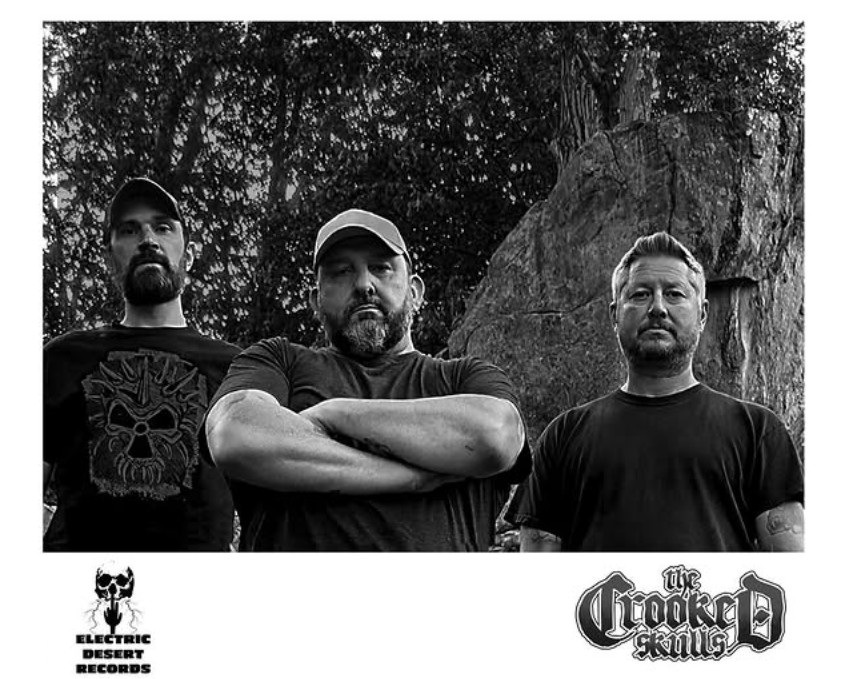
This isn’t the first time we’ve talked about them. A few months ago, I reviewed what they’d been putting out over the past year and a half. But now The Crooked Skulls, out of New Jersey, are about to release their first full-length. And I needed to dig deeper.
No es la primera vez que hablamos de ellos. Hice una reseña hace unos meses de lo que llevan sacando un año y pico. Pero ahora The Crooked Skulls, desde New Jersey, están a punto de sacar su primera larga duración. Y necesitaba saber más.
RESEÑA en Dirty Rock Magazine: THE CROOKED SKULLS demuestran que el sludge sigue vivo con Hivemind y “Iron Smile”
I had a great time interviewing Pete (guitar, vocals), Dave (bass, vocals) and Chuck (drums) as they talked about growing up on Pantera, Metallica, Melvins, some hardcore, some desert rock, and one pretty straightforward idea: play loud, play heavy, and make it groove.
En esta entrevista, Pete (guitarra y voces), Dave (bajo y voces) y Chuck (batería) hablan de crecer entre Pantera, Metallica, Melvins, algo de hardcore, algo de desert, y una idea bastante simple: tocar alto, tocar heavy, y tocar con groove.
Their December 2024 EP Hivemind left no room for confusion. Bass lines rumbling like a Harley. Riffs that don’t stop. A clear preference for groove over empty flash. Then “Iron Smile” dropped, and suddenly Bob Balch (Fu Manchu) shows up with a solo. No overthinking. Just plug in, let it rip, and make it count. That mindset of “don’t overanalyze it, make it sound real” runs through most everything they say.
Su EP Hivemind, de diciembre 2024, ya dejaba claro por dónde iban los tiros: bajos que suenan como un motor al ralentí, riffs que no cesan y una obsesión sana por el groove antes que por el virtuosismo. Pero la conversación se pone interesante cuando aparece “Iron Smile” y, de repente, Bob Balch (Fu Manchu) mete un solo orgánico, directo y sin sobremesa teórica. Esa filosofía de no pensarlo demasiado y hacerlo sonar real parece atravesar todo lo que cuentan.
What stands out isn’t the influence list itself – Dimebag, early thrash, hardcore pulse, Seattle, glam, the California desert – but how they handle it. Chuck talks about metal and thrash, but always in service of the pocket. Pete is a riff machine, keeping them simple but crushing – no filler. Dave casually coins a new genre (“garage metal”) as he tries to describe the “Crooked Skulls sound,” even if no one really wants to define it.
Lo más llamativo no es la lista de influencias, que es transparente y asumida (Dimebag, el thrash primitivo, el pulso del hardcore, Seattle, glam, el desierto californiano), sino cómo las gestionan. Chuck habla de metal, thrash y el groove, pero al servicio del pocket. Pete insiste en riffs que salen a todas horas, en mantenerlo simple pero demoledor, en evitar el relleno. Dave acuña el “garage metal” y acepta que existe algo así como un “sonido Crooked Skulls”, aunque nadie sepa definirlo del todo.
Midnight Sun, out March 27 (Electric Desert Records), was recorded and mixed by John Naclerio at Nada Recording in Montgomery, New York, and mastered at Crystal Clear Studios in Texas by Kent Stump (Wo Fat). Nine tracks, including three reworked from the EP. It’s not a hard left turn, but it is a bit of a shift. “Judgment Day” stretches out, breathes, leans into something almost expansive. “Ashes I See” does the opposite: a relentless sledgehammer of a riff, anchored by a bass synth pedal that sounds like a Hammond organ that came together almost by accident in rehearsal. Growth without losing the essence. Each track standing on its own.
Midnight Sun, el LP que saldrá el 27 de marzo (Electric Desert Records) y fue grabado y mezclado por John Naclerio de Nada Recording en Montgomery, Nueva York, y masterizado en Crystal Clear Studios (Texas) por Kent Stump (Wo Fat), son nueve temas, tres revisados del EP. No suena a volantazo, pero sí a desplazamiento. “Judgment Day” respira más, se expande, coquetea con una amplitud casi espacial. “Ashes” es lo contrario: un martillo insistente con un pedal de sinte de bajo que suena a Hammond y apareció casi por accidente en el local de ensayo. Evolución sin dejar de ser The Crooked Skulls. Cada canción con identidad propia.
And then there’s the live show. Heavy, yes. Static, no. Reading the room. Playing with intent. They talk about community, about building relationships with other bands, about not assuming people will leave the comfort of the couch in 2026 to go see a live band in a club. No grand speeches. No false humility. Just hard work, focus and the sense that they’re still defining their perimeter while quietly pushing it outward.
Y luego está el directo. Pesado, sí, pero no estático: lectura de la sala e intención. Hablan de comunidad, de currar relaciones con otras bandas, de no dar por hecho que la gente va a salir de casa en 2026 para meterse en un club. No hay discurso épico, tampoco falsa modestia. Hay trabajo, intención y la sensación de que todavía están definiendo su perímetro mientras ya lo están ampliando.
THE CROOKED SKULLS: Web I Bandcamp I Instagram I Youtube
ENTREVISTA COMPLETA – THE CROOKED SKULLS:
English below
JESSICA: Hola, gracias por sentaros hoy con nosotros en Dirty Rock Magazine. Tenemos aquí a The Crooked Skulls, llegados desde Nueva Jersey. Da gusto teneros a los tres al mismo tiempo. Tengo un colega en Texas que tiene una banda llamada Sons of Gulliver, y creo que compartisteis cartel con ellos o hicisteis algo de promo juntos, ahora mismo no lo recuerdo bien. Pero el nombre The Crooked Skulls me llamó la atención, así que empecé a escucharos y me enganché bastante a vuestro EP Hivemind, aunque ya llevaba un tiempo publicado. Luego me metí de lleno con vuestro single “Iron Smile”, que acababais de sacar por entonces. Escuché ese solo y me enteré de que lo había grabado Bob Balch, de Fu Manchu, y me picó la curiosidad. Tenía que hablar con vosotros. Para empezar, ¿qué se siente al recibir cobertura hasta aquí, en Madrid, España?
DAVE: Es increíble.
PETE: Una locura. A veces recibimos más atención fuera que en nuestro propio país, así que es la leche.
JESSICA: Bueno, a ver si podéis veniros a tocar por aquí. Tenemos una escena underground bastante potente, sobre todo en Madrid. Enseguida hablamos de vuestras grabaciones, pero para situar a la gente: si alguien no ha escuchado nunca a la banda, ¿cómo describiríais la música que hace The Crooked Skulls?
PETE: Es pesada. Yo diría que es una mezcla. Hay bastante sludge, rollo desert rock, cosas stoner… En realidad es la suma de todo lo que escuchamos. Intentamos coger las influencias que nos molan y juntarlas en algo que suene a nosotros. Hay groove, hay contundencia.
CHUCK: Creo que Dave fue quien se inventó lo de “garage metal” (risas).
DAVE: Sí, al principio, cuando estábamos intentando ponerle nombre a lo que hacíamos, a cómo sonábamos.
PETE: ¡Somos RUIDOSOS! (risas)
JESSICA: (risas) ¡Desde luego! Eso es verdad. Y sí, el groove se nota muchísimo. Cuando escucho Hivemind, para mí es lo más evidente. Es pesado, pero tiene ese balanceo —sobre todo en las líneas de bajo. Son sencillas, atronadoras, y engordan los riffs justo cuando toca. Hice una reseña del EP y comparé —sobre todo en la intro de “Let Me Out”— ese grave con el ralentí de una Shovelhead de Harley. ¿De dónde sale ese rugido?
PETE: Me tira mucho lo que tiene groove. Black Label Society, Pantera, bandas así. Temas que balancean, que se te quedan, que tienen gancho. Algo con lo que me siento cómodo cuando estoy tocando. No lo pienso demasiado; simplemente sale. Si se percibe eso, genial (risas).
JESSICA: También se notan los pinch harmonics —esa influencia de Dimebag Darrell.
DAVE: Ya le digo yo siempre: nunca hay demasiados pinch harmonics, nunca hay demasiado Dimebag. Así que, ¿de ahí vienen parte de tus influencias con la guitarra?
PETE: Sí, claro. Pantera fue enorme para mí. Dimebag fue una influencia muy grande. Me encanta ese estilo agresivo, esos armónicos chillones. Le dan carácter.
JESSICA: Por ejemplo, “Bury It” tiene ese aire metalero de finales de los 80 y principios de los 90 —casi con doble bombo en algunos tramos. Déjame adivinar, Chuck: de pequeño eras muy de Metallica.
CHUCK: Sí, totalmente. Metallica fue muy importante para mí. También mucho thrash. Me gusta esa sensación de empuje, de doble bombo marcando el paso, pero intento que siga teniendo groove para que encaje con lo que hacen estos dos. Se trata de equilibrar la pegada con el pocket. Pero sí, Metallica fue clave. Kill ’Em All es probablemente mi disco favorito suyo. Esa energía del thrash temprano, la velocidad, lo crudo… eso se me quedó grabado. También vengo más del hardcore. Temas rápidos, directos, con mucha energía en vivo —ese punto agresivo ha marcado mucho mi forma de tocar.
JESSICA: ¿Y vosotros? ¿Con qué música crecisteis?
DAVE: Nuestras influencias no son nada raro ni rebuscado. Melvins, Pantera, Slayer, Metallica… todo eso se nota en lo que hacemos. Incluso cosas como Misfits o Motörhead. Hay mucha base común entre el metal clásico y el punk. A Chuck le flipa el death metal, pero en nuestro sonido no hay tanto death metal puro y duro.
PETE: Yo tiro de muchos sitios distintos. Empecé con el Sabbath más temprano y bandas de ese rollo, pero escucho de todo. Puedo sacar algo de una banda sonora ochentera o del glam o el grunge de los 90. Si me suena bien, me da igual quién lo toque. Si me mueve algo, intento meter un poco de eso en lo que hacemos.
JESSICA: Te entiendo. Quien me conozca sabe que detesto las etiquetas. Cuando reseñé Hivemind, dije que sonabais como toda la buena música con la que crecí. Pero me sonáis más a Down que a Kyuss, aunque contéis con Bob Balch de Fu Manchu en “Iron Smile”. ¿Erais muy de bandas del desierto? ¿Cómo surgió esa conexión?
DAVE: En realidad, esa era la idea cuando empezamos.
PETE: Siempre me ha gustado ese rollo desert rock. De más joven me metí mucho en Kyuss y toda esa escena. Venía del thrash ochentero y el glam noventero, y de repente escuché ese sonido más sucio y pesado del desierto y me hizo clic. Me sonaba auténtico, nada impostado. Daba la sensación de que esas bandas simplemente estaban tocando y pasándolo bien, y eso se me quedó. También estaba escuchando cosas como Mother Love Bone o Alice in Chains. Y llevaba mucho tiempo oyendo a Fu Manchu. En cuanto a Bob Balch, en los últimos años empecé a tener contacto con él, a tocar algunas cosas, hablar de teoría y de equipo. Nos hicimos colegas, y así acabó participando en “Iron Smile”. Simplemente le pregunté si le apetecía grabar un solo, y le pareció bien. Fue así de sencillo. Me dijo: mándame la pista y la escucho. Y pum, a los pocos minutos ya teníamos el solo.
JESSICA: Hola, gracias por sentaros hoy con nosotros en Dirty Rock Magazine. Tenemos aquí a The Crooked Skulls, llegados desde Nueva Jersey. Da gusto teneros a los tres al mismo tiempo. Tengo un colega en Texas que tiene una banda llamada Sons of Gulliver, y creo que compartisteis cartel con ellos o hicisteis algo de promo juntos, ahora mismo no lo recuerdo bien. Pero el nombre The Crooked Skulls me llamó la atención, así que empecé a escucharos y me enganché bastante a vuestro EP Hivemind, aunque ya llevaba un tiempo publicado. Luego me metí de lleno con vuestro single “Iron Smile”, que acababais de sacar por entonces. Escuché ese solo y me enteré de que lo había grabado Bob Balch, de Fu Manchu, y me picó la curiosidad. Tenía que hablar con vosotros. Para empezar, ¿qué se siente al recibir cobertura hasta aquí, en Madrid, España?
DAVE: Es increíble.
PETE: Una locura. A veces recibimos más atención fuera que en nuestro propio país, así que es la leche.
JESSICA: Bueno, a ver si podéis veniros a tocar por aquí. Tenemos una escena underground bastante potente, sobre todo en Madrid. Enseguida hablamos de vuestras grabaciones, pero para situar a la gente: si alguien no ha escuchado nunca a la banda, ¿cómo describiríais la música que hace The Crooked Skulls?
PETE: Es pesada. Yo diría que es una mezcla. Hay bastante sludge, rollo desert rock, cosas stoner… En realidad es la suma de todo lo que escuchamos. Intentamos coger las influencias que nos molan y juntarlas en algo que suene a nosotros. Hay groove, hay contundencia.
CHUCK: Creo que Dave fue quien se inventó lo de “garage metal” (risas).
DAVE: Sí, al principio, cuando estábamos intentando ponerle nombre a lo que hacíamos, a cómo sonábamos.
PETE: ¡Somos RUIDOSOS! (risas)
JESSICA: (risas) ¡Desde luego! Eso es verdad. Y sí, el groove se nota muchísimo. Cuando escucho Hivemind, para mí es lo más evidente. Es pesado, pero tiene ese balanceo —sobre todo en las líneas de bajo. Son sencillas, atronadoras, y engordan los riffs justo cuando toca. Hice una reseña del EP y comparé —sobre todo en la intro de “Let Me Out”— ese grave con el ralentí de una Shovelhead de Harley. ¿De dónde sale ese rugido?
PETE: Me tira mucho lo que tiene groove. Black Label Society, Pantera, bandas así. Temas que balancean, que se te quedan, que tienen gancho. Algo con lo que me siento cómodo cuando estoy tocando. No lo pienso demasiado; simplemente sale. Si se percibe eso, genial (risas).
JESSICA: También se notan los pinch harmonics —esa influencia de Dimebag Darrell.
DAVE: Ya le digo yo siempre: nunca hay demasiados pinch harmonics, nunca hay demasiado Dimebag. Así que, ¿de ahí vienen parte de tus influencias con la guitarra?
PETE: Sí, claro. Pantera fue enorme para mí. Dimebag fue una influencia muy grande. Me encanta ese estilo agresivo, esos armónicos chillones. Le dan carácter.
JESSICA: Por ejemplo, “Bury It” tiene ese aire metalero de finales de los 80 y principios de los 90 —casi con doble bombo en algunos tramos. Déjame adivinar, Chuck: de pequeño eras muy de Metallica.
CHUCK: Sí, totalmente. Metallica fue muy importante para mí. También mucho thrash. Me gusta esa sensación de empuje, de doble bombo marcando el paso, pero intento que siga teniendo groove para que encaje con lo que hacen estos dos. Se trata de equilibrar la pegada con el pocket. Pero sí, Metallica fue clave. Kill ’Em All es probablemente mi disco favorito suyo. Esa energía del thrash temprano, la velocidad, lo crudo… eso se me quedó grabado. También vengo más del hardcore. Temas rápidos, directos, con mucha energía en vivo —ese punto agresivo ha marcado mucho mi forma de tocar.
JESSICA: ¿Y vosotros? ¿Con qué música crecisteis?
DAVE: Nuestras influencias no son nada raro ni rebuscado. Melvins, Pantera, Slayer, Metallica… todo eso se nota en lo que hacemos. Incluso cosas como Misfits o Motörhead. Hay mucha base común entre el metal clásico y el punk. A Chuck le flipa el death metal, pero en nuestro sonido no hay tanto death metal puro y duro.
PETE: Yo tiro de muchos sitios distintos. Empecé con el Sabbath más temprano y bandas de ese rollo, pero escucho de todo. Puedo sacar algo de una banda sonora ochentera o del glam o el grunge de los 90. Si me suena bien, me da igual quién lo toque. Si me mueve algo, intento meter un poco de eso en lo que hacemos.
JESSICA: Te entiendo. Quien me conozca sabe que detesto las etiquetas. Cuando reseñé Hivemind, dije que sonabais como toda la buena música con la que crecí. Pero me sonáis más a Down que a Kyuss, aunque contéis con Bob Balch de Fu Manchu en “Iron Smile”. ¿Erais muy de bandas del desierto? ¿Cómo surgió esa conexión?
DAVE: En realidad, esa era la idea cuando empezamos.
PETE: Siempre me ha gustado ese rollo desert rock. De más joven me metí mucho en Kyuss y toda esa escena. Venía del thrash ochentero y el glam noventero, y de repente escuché ese sonido más sucio y pesado del desierto y me hizo clic. Me sonaba auténtico, nada impostado. Daba la sensación de que esas bandas simplemente estaban tocando y pasándolo bien, y eso se me quedó. También estaba escuchando cosas como Mother Love Bone o Alice in Chains. Y llevaba mucho tiempo oyendo a Fu Manchu. En cuanto a Bob Balch, en los últimos años empecé a tener contacto con él, a tocar algunas cosas, hablar de teoría y de equipo. Nos hicimos colegas, y así acabó participando en “Iron Smile”. Simplemente le pregunté si le apetecía grabar un solo, y le pareció bien. Fue así de sencillo. Me dijo: mándame la pista y la escucho. Y pum, a los pocos minutos ya teníamos el solo.
JESSICA: Vaya. No suena en absoluto a lo que ha estado haciendo en otros proyectos. O sea, que no fue simplemente coger un solo y encajarlo ahí sin más; se siente bastante natural.
PETE: Una de las cosas que siempre dice Bob es: “No lo pienses, hazlo”. Métete y deja que fluya. Así lo planteó. No estuvo dándole vueltas. Estoy seguro de que cuando empezó no sabía qué iba a salir, pero se marcó un solo brutal. Sonó increíble y estamos encantadísimos de que se sumara.
JESSICA: Encaja perfecto. Entra, cumple y se va. Y me imagino que Bob no toca ni graba con cualquiera. Vosotros lleváis muchos años tocando, aunque no siempre juntos, ¿no?
PETE: Sí, llevo tocando toda la vida. Con pausas, claro. Al principio era quedar con colegas y hacer ruido. Luego creces, llegan el trabajo y las responsabilidades, y hay que centrarse en eso. Ahora estamos en un punto en el que podemos volver a tomárnoslo en serio. Esto empezó como algo para pasarlo bien y ver qué salía. Y después fue: vale, ¿hasta dónde puede llegar? ¿Cuál es el siguiente paso? Ir avanzando, conectar con otras bandas, crear comunidad, conocer a gente muy guay. En el fondo es eso: nos lo pasamos bien. Y si llegan cosas buenas, no las vamos a rechazar. Las disfrutamos, curramos y seguimos intentando mejorar.
JESSICA: Es genial que todo esté creciendo de forma tan orgánica. Y también mola que se note la evolución. No lleváis tanto tiempo, pero “Iron Smile” suena distinto al resto de Hivemind. He podido escuchar un par de temas de vuestro próximo disco, Midnight Sun, y me da la sensación de que vais hacia algo menos sludge. El breakdown de “Judgment Day”, por ejemplo, tiene casi un aire a “Negasonic Teenage Warhead”. En Hivemind ya había guiños al space rock, como en “Skull Bong”. Y no me sorprende, porque Monster Magnet tiene ese groove tan evidente en vuestra música. Seguís siendo doom, seguís siendo muy pesados, pero también sois una banda joven. ¿Creéis que en este nuevo álbum habéis encontrado vuestro sonido?
PETE: Diría que estamos en ello. Grabamos los temas por fases, y se nota la progresión. Los primeros se compusieron en un momento distinto a los últimos. “Bury It”, “Skull Bong” y parte del material más antiguo se sienten diferentes a “Midnight Sun”, “Broken”, “Slow Steel”, “Iron Smile” y ahora los dos más recientes, “Ashes” y “Judgment Day”. Hay una evolución clara, pero lo que me gusta es que cada canción se sostiene por sí sola. No suenan iguales, pero encajan entre ellas.
DAVE: Sí, al final todas siguen sonando a nosotros.
JESSICA: Sí, el “sonido marca Crooked Skulls”.
DAVE: ¡Exacto! (risas) ¡Lo que sea que signifique eso!
JESSICA: Chuck, comentabas que te va lo más thrash y pesado. ¿Cómo lo equilibras con el groove?
CHUCK: A estas alturas es bastante natural. Hemos crecido juntos como banda y ellos me lo ponen fácil. Yo me apoyo en lo que soy: ritmos firmes, sólidos, que mantengan la canción avanzando, y dejo que ellos hagan su parte. Mi papel es que todo suene fuerte y no pierda empuje.
PETE: Y yo a veces le saco de su zona de confort (risas). Pero siempre responde y lo clava.
JESSICA: (risas) No es fácil mantenerlo pesado y con groove sin tirar de blast beats y cosas así.
PETE: Intentamos que sea sencillo pero contundente. Añadir algún detalle cuando hace falta, pero no nos van los rellenos imposibles ni el exhibicionismo. Que el groove haga el trabajo.
JESSICA: Eso se percibe. Sin adornos, sin tonterías. Hablando del nuevo disco… Dave, he leído que eres muy fan de “Judgment Day”. ¿Qué tiene de especial? ¿Refleja el momento actual de la banda?
DAVE: Siento que resume lo que veníamos haciendo y, a la vez, deja entrever hacia dónde podemos ir. Tiene esa parte larga de solo, muy en la línea de Monster Magnet que mencionabas —más que espacial, expansiva. La canción respira más. Creo que, sin proponérnoslo del todo, nos estamos moviendo un poco en esa dirección. Pero luego “Ashes”, que grabamos más o menos al mismo tiempo, es lo contrario. Es un riff que no afloja.
PETE: Sí, es como estar lanzando mazazos sin parar.
JESSICA: Me encanta la intro de ese tema.
PETE: Salió trasteando sin más. Ni lo pensé demasiado; como el 90% de mis riffs, salen solos de la guitarra. De repente digo: “Eh, esto tiene gancho”. Sonaba un poco disonante, algo raro, y me atrapó. A partir de ahí lo desarrollamos. Soy muy de riffs. A veces se van por caminos distintos y luego intentamos unirlo todo de forma interesante. Eso es algo que me gusta de nuestra música —sin echarnos flores—
JESSICA: ¡Deberíais! (risas)
PETE: Bueno, sí… Me gusta que no repitamos los mismos patrones una y otra vez ni metamos relleno por meter. Que cada tema tenga su identidad. “Ashes” es un buen ejemplo.
JESSICA: ¿Hay teclados o un sinte en “Ashes I See”?
DAVE: (risas) Es un pedal de sintetizador para el bajo. Suena igual que un Hammond. Estábamos probando cosas en el local y dijimos: “Esto tiene que ir en una canción”. Y Pete estaba tocando un riff al mismo tiempo y todo encajó.
(risas)
PETE: Sí, fue una de esas cosas raras que pasan sin planearlas.
JESSICA: Pues funciona. Llena el espacio sin pasarse.
DAVE: Sí, por ejemplo en “Judgment Day” no habría funcionado.
JESSICA: ¿Midnight Sun es un LP completo?
PETE: Sí, nueve canciones. Hemos incluido tres del EP, pero remasterizadas. Trabajamos con Crystal Clear Studios, en Texas. Kent Stump, de Wo Fat, ha trabajado con muchas bandas del sector y tiene un oído increíble. Y también con Nada Recording, en Montgomery, Nueva York, con la experiencia de John Naclerio en la grabación y mezcla. Con los dos metidos en el proyecto, el resultado suena impresionante.
JESSICA: Y sale el 6 de marzo, ¿verdad?
PETE: Esa era la fecha provisional, pero ahora apunta más al 27 de marzo.
JESSICA: Vale, finales de marzo. ¿Cuál es el sueño para este disco?
PETE: No sé… ¿que alguien lo escuche?
(risas)
JESSICA: ¡A lo grande! (risas)
PETE: Que a la gente le guste, que nadie lo tire por la ventanilla mientras va a toda pastilla por la autopista (risas). No, en serio: le hemos puesto mucho esfuerzo. Si la gente lo encuentra, lo hace suyo y lo disfruta, para nosotros ya es enorme. Seguiremos creciendo, tocando más, desarrollando el directo, empezar a nivel regional y expandir desde ahí. Al final lo sacamos porque creemos en estas canciones y pensamos que tienen que compartirse.
JESSICA: Veo que tocáis con Borracho el sábado en Brooklyn. ¿Cómo afrontáis ese concierto? ¿Probaréis material nuevo?
PETE: Sí, “Ashes” y “Judgment Day” estarán en el setlist. Abrimos para bandas increíbles: Borracho, Guhts, del área del Hudson Valley. En directo son una pasada, muy visuales. Borracho es una banda de músicos para músicos. Son buenísimos. Y Sun Voyager también, están geniales. De hecho, su guitarrista toca en otra banda llamada Heavy Temple, así que echadles un ojo. Él hizo las voces invitadas en “Judgment Day”. Canta conmigo el estribillo y le da otra capa. En ese coro hay tres voces. Le aporta mucha profundidad. Va a ser un concierto muy especial.
JESSICA: ¿Cómo es un directo de Crooked Skulls?
CHUCK: ¡heavy!
(risas)
PETE: Desde luego no nos quedamos quietos (risas). Nos gusta interactuar con el público. Mirar a la gente, sentir la energía de la sala. En cada concierto aprendemos algo e intentamos crecer. Para el siguiente quizá incorporemos proyecciones detrás del escenario. Es enérgico, pero con intención. Entramos, leemos el ambiente y tocamos con la idea de arrasar.
JESSICA: ¿Con proyecciones y todo? Suena a que estáis cuidando mucho vuestra identidad. Hoy en día una banda tiene que ser influencer, su propia agencia de prensa, promotora, productora, tienda de merchandising… ¿Cómo lleváis todo eso?
PETE: Es alucinante la cantidad de trabajo que hay detrás. Hay mucho que aprender. Por suerte cuento con ayuda. Hablo con gente del sector, pido consejos, intento empaparme. Cuanto más aprendo, más ajustamos lo que hacemos. Creo que lo estamos haciendo bien. Electric Desert Records ha fichado el disco, y parte del motivo fue ese. Por un lado, la calidad de la producción —vieron que nos importa trabajar con gente que sabe lo que hace—. Y por otro, que estamos moviéndonos, intentando que pasen cosas, creando relaciones, apoyando a otras bandas, fortaleciendo la escena. Después del COVID es complicado —va menos gente a los conciertos—. Pero a los que vienen queremos darles una experiencia potente, un show que merezca la pena y que todo el mundo sienta que forma parte de algo.
JESSICA: Para los fans que quieran apoyaros, ¿cuál es la mejor manera ahora mismo?
PETE: Venid a los conciertos. Participad. Salid de casa si podéis. Sé que no es fácil. Pero salid, id a la sala. La tele no te da esa conexión. El sofá es cómodo, pero después de un rato te deja agotado. Venid a un concierto, hablad con la gente, escuchad buena música y vamos a darlo todo. Solo se vive una vez. ¿Vas a pasarte la vida delante de Netflix o vas a ir a ver un directo?
CHUCK: Así empezó la banda. Queríamos tocar en vivo y pasarlo bien. Y como decíamos, nuestro repertorio es bastante variado, así que siempre hay algo para alguien.
JESSICA: La voz se está corriendo, tanto en Estados Unidos como aquí en Europa. Por desgracia se nos acaba el tiempo. ¿Algo más que queráis añadir antes de despedirnos?
PETE: Echad un vistazo al merch, pillad una camiseta, visitad nuestra web —thecrookedskulls.com— para más información. Midnight Sun sale el 27 de marzo. Si lo escucháis, os agradecemos muchísimo el apoyo. Venid a los conciertos, comprad el LP, apoyad vuestra escena local, apoyad a las bandas cercanas y, sobre todo, salid ahí fuera y disfrutadlo. ¡Gracias!
JESSICA: Muchas gracias por vuestro tiempo, chicos.
FULL INTERVIEW WITH THE CROOKED SKULLS:
JESSICA: Hey there, thanks for sitting down with us today at Dirty Rock Magazine. We have The Crooked Skulls with us here from New Jersey. It’s fun to have all three of you at the same time. I have a buddy who has a band in Texas called Sons of Gulliver, and you guys either shared a bill with them or did some promo together, I can’t remember exactly. But I liked the name The Crooked Skulls, so I started listening and I really dug your EP Hivemind even though it had already been out for a while. But then I really got into your single “Iron Smile.” You had just put it out at the time. I heard that solo and realized it was done by Bob Balch from Fu Manchu, and I got really curious. I had to talk to you guys. First of all, what’s it like getting coverage all the way over here in Madrid, Spain?
DAVE: It’s unbelievable.
PETE: It’s crazy. We get more attention overseas than we do in our own country sometimes, so it’s awesome.
JESSICA: Well, hopefully you’ll be able to get over here and tour. We have a pretty big underground scene, especially in Madrid. We’ll get into your recordings in a second, but just to orient people—if someone has never heard of the band before, how would you describe the music The Crooked Skulls play?
PETE: It’s heavy. I’d say it’s kind of a mix. There’s definitely some sludge in there, some desert rock vibes, some stoner stuff. It’s really just a combination of everything we listen to. We try to take all the influences we like and put them together into something that feels like us. There’s groove, there’s heaviness.
CHUCK: I think Dave coined the phrase “garage metal” (laughs)
DAVE: Yeah, that was at first when we were trying to figure out what to call it, what we sound like.
PETE: We’re LOUD! (laughs)
JESSICA: (laughs) Definitely loud! (laughs) That’s true! And yeah, you can definitely hear the groove. When I listen to Hivemind, the groove was probably the most present thing for me. It’s heavy, but it grooves – especially in the bass lines. They’re simple, they’re thundering, and they thicken the riffs at the right time. I did a review of the EP and compared (especially on the intro of “Let Me Out”) the low-end to the idling of a Shovelhead (Harley). Where does that rumble come from?
PETE: I like a lot of groove-oriented stuff. Black Label Society, Pantera, bands like that. Songs that really swing and catchy. Something that I’m comfortable to listen to when I’m playing. I don’t really think about; it just kind of comes out naturally. If you hear that, great! (laughs)
JESSICA: You can hear the pinch harmonics too – that Dimebag Darrell influence.
DAVE: Yeah, I always tell him, there can never be too many pinch harmonics, never too much Dimebag influence. So is that where some of your guitar influences come from?
PETE: Oh yeah, definitely. Pantera was huge for me. Dimebag was a big influence. I love that aggressive, squealing harmonic style. It just adds attitude.
JESSICA: For example, “Bury It” has those late ’80s, early ’90s metal vibes – almost a double-bass drumming in parts. Let me guess, Chuck, you were really into Metallica growing up?
CHUCK: Yeah, for sure. Metallica was big for me. A lot of thrash stuff too. I like that driving, double-kick feel, but I also try to keep it groovy so it fits with what these guys are doing. It’s about balancing the heaviness with the pocket. But yeah, Metallica was definitely huge for me. Kill ’Em All is probably my favorite of theirs. That early thrash energy, the speed, the rawness – that really stuck with me. I also come from more of a hardcore background. Faster, driven songs, live energy – that kind of aggressive feel definitely shaped the way I play.
JESSICA: What about the rest of you guys? What music did you grow up listening to?
DAVE: Our influences aren’t anything too crazy or obscure. Melvins, Pantera, Slayer, Metallica – you can hear that in what we do. Even stuff like the Misfits and Motörhead. There’s a lot of overlap in that classic metal and punk foundation. Chuck loves death metal, but there’s not a lot of straight-up death metal in our sound.
PETE: I pull from a lot of different places. It started with early Sabbath and bands like that, but I listen to so many genres. I could pull something from an ’80s movie soundtrack or from ’90s glam or grunge. If it sounds good to me, I don’t really care who’s playing it. If it moves me, I’ll try to bring a little bit of that into what we’re doing.
JESSICA: I agree. Anyone who knows me knows I hate putting labels on things. When I reviewed Hivemind, I said you guys sound like all the good music I grew up listening to. But you sound more Down than Kyuss even though you featured Bob Balch [Fu Manchu] on your single “Iron Smile”. Were you into desert bands? How did that connection come about?
DAVE: That was what it was supposed to be when we started.
PETE: I’ve always been into that desert rock stuff. When I was younger, I got into bands like Kyuss and that whole scene. I was coming out of that 80s thrash and 90s glam rock and suddenly I heard that dirtier, heavier desert sound and it just clicked for me. It felt real—like it wasn’t fabricated. Those bands just sounded like they were just jamming and having a great time and that really stuck with me. I was getting into stuff like Mother Love Bone and Alice in Chains. And you know, I had been listening to Fu Manchu for a long time and as for Bob Balch, in recent years, I started connecting with him, playing some stuff and talking theory and gear. We became friendly, and that’s how he ended up on “Iron Smile.” I just asked him if he’d be into doing a solo, and he was cool about it. It was very simple. He told me, send me the track and I’ll give it a listen and boom, a few minutes later we had the solo.
JESSICA: Wow. It doesn’t really sound like what he’s been doing with some of his other projects. So it wasn’t just a case of ripping a solo and dropping it in there—it sounds like it was pretty organic.
PETE: One of Bob’s big things is, “Don’t think about it—just do it.” Just get in there and let it flow. That’s kind of how he approached it. It wasn’t overthought. I can guarantee he had no idea what was going to come out of it when he started, but he absolutely killed that solo, and it sounded great and we’re really glad he did.
JESSICA: It’s a great fit. He gets in, does what he has to do, and gets out. Well, I’m sure Bob doesn’t just play with anybody. And especially not record with just anybody. You guys have all been playing for a long time, even if not together, right?
PETE: Yeah, I’ve been playing for years. There were breaks here and there. In the early days it was just playing with friends, jamming. Then you get a little older, life happens—you’ve got to focus on work and responsibilities. Now we’re at a place where we can take it seriously again. We started this as a fun project just to hang out and see what would come of it. Then it was like, okay, where can this go? What’s the next step? It was just taking the next step, building relationships with other bands, building a community, met some really cool people. It’s fun – that’s the core of it. We enjoy it. And when good things happen, we’re not going to turn them down. We’re going to enjoy them, work hard and try to keep improving.
JESSICA: It’s fantastic that it’s coming together so organically. It’s also cool that you can hear the evolution. You haven’t been around that long, but “Iron Smile” sounds different from the rest of Hivemind. I was lucky enough to hear a couple of tracks from your upcoming album, Midnight Sun, and to me it sounds like you’re leaning into a less sludgier direction. The breakdown in “Judgment Day,” for example, has almost a “Negasonic Teenage Warhead” vibe. You had some space rock nods on Hivemind with “Skull Bong” for example. And it doesn’t surprise me because Monster Magnet has that groove that it so obvious in your music. You’re still doomy, still very heavy, but you’re also still a young band. Do you think you’ve found your sound on this new album?
PETE: I’d say we’re getting there. We recorded the songs in stages, so you can actually hear the progression. The earlier tracks were written at a different time than the later ones. Songs like “Bury It” “Skull Bong” and some of the earlier material feel different from “Midnight Sun,” “Broken,” “Slow Steel,” “Iron Smile,” and now the latest two,“Ashes,” and “Judgment Day.” There’s a progression but what I like about this album is that each song kind of stands on its own. None of them really sound the same, but they still belong together.
DAVE: Yeah, I mean, they all still sound like us.
JESSICA: Yeah, the “Crooked Skulls trademark sound”
DAVE: Right! (laughs) whatever that is!
JESSICA: Chuck, you mentioned being into heavier thrashier stuff. How do you balance that with the groove?
CHUCK: It’s actually pretty easy at this point. We’ve grown together as a band, and these guys make it easy for me. I lean on my roots – hard, steady beats, keeping the song trucking and I let these guys do their thing. My job is to keep it strong and moving.
PETE: Yeah and I kind of force him out of his comfort zone every now and then. (laughs) But he responds well and always does a great job.
JESSICA: (laughs) It’s not easy to keep things heavy and groovy without going into blast beats and stuff.
PETE: We try to keep it simple but powerful. Add a little flair where it’s needed, but we’re not into crazy fills or showmanship. We just let the groove carry it.
JESSICA: That definitely comes through. It’s no-frills, no bullsh1t. Speaking of the new album… Dave, I read that you’re a big fan of “Judgment Day.” What’s special about it? Does it capture where the band is right now?
DAVE: It feels like a summation of what we had been doing and also a glimpse of where I think this is going. It has that long solo “Monster Magnet” section that you mentioned – not so much spacey, but actually expansive. There’s more breathing room in that song. Yeah, I think we’re unintentionally moving a little bit in that direction. But then “Ashes,” which we recorded around the same time, is the opposite. It’s just a riff that keeps going.
PETE: Yeah, it feels like I’m just slinging a sledgehammer.
JESSICA: I love the intro on that one.
PETE: That came from just messing around. I wasn’t even thinking about it too much; much like 90% of my riffs – they just come out of my axe. Suddenly I’m just like “hey, that sounds catchy!” That riff just sounded dissonant and a little off, and it caught my ear. Then we built on it from there. I’m riffy. Sometimes they go in different directions, and we try to bring them back together in a way that feels interesting. That’s one thing that I like about our music, not to pat ourselves on the back
JESSICA: You should! (laughs)
PETE: Well, yeah, I just like that our music doesn’t have the same patterns and riffs again and again and filler. I like that everything basically stands on its own and “Ashes” is a good example of that.
JESSICA: Are there keys or a synth on that track [“Ashes I See”]?
DAVE: (laughs) It’s actually a bass synth pedal. It sounds exactly like a Hammond organ. We were messing around in practice and thought, “Woah, we need that in a song!” And Pete was doing a riff at the same time and it all kind of came together.
(laughs)
PETE: Oh yeah, that was a weird organic thing that happened.
JESSICA: Well, it works. It fills space without overdoing it.
DAVE: Yeah, if we had been working on for example “Judgment Day” it wouldn’t have worked.
JESSICA: Is Midnight Sun a full LP?
PETE: Yeah, there are nine songs. We included three tracks from the EP, but they’ve been remastered. We used CRYSTAL CLEAR STUDIOS out of Texas. KENT STUMP from WO FAT has worked with a lot of bands in the industry, and he has such a great ear. And we also used Nada Recording in Montgomery, New York with John [Naclerio]’s expertise on the recording and mixing. With both of them working on it all, it just sounds incredible.
JESSICA: And it’s coming out March 6th, right?
PETE: That was the tentative date, but now it’s looking more like March 27th.
JESSICA: Okay, end of March. What’s the dream for this album?
PETE: I dunno, that someone listens to it?
(laughs)
JESSICA: Dream big! (laughs)
PETE: That people like it, that someone doesn’t hock it out the window as they’re doing 70 down the highway. (laughs) No, I mean we put a lot of effort into it. If people find it, absorb it, and enjoy it, that’s huge for us. We’ll keep growing, keep playing, expanding on the live aspect, start regionally and grow from there. At the end of the day, we’re putting it out there because we believe in the music and think it should be shared.
JESSICA: I see you’re playing with Borracho next Saturday in Brooklyn. How do you feel going into that show? Are you trying out new material?
PETE: Yeah, “Ashes” and “Judgment Day” will be on the setlist. We’re opening for some incredible bands – BORRACHO, GUHTS, out of the Hudson Valley area. They’re an incredible live band, very visual. Borracho, you know – they’re a band’s band. So good. And SUN VOYAGER, they’re great, too. In fact, their guitarist also plays with another band called HEAVY TEMPLE, so check those guys out. He actually did the guest vocals on “Judgment Day.” He sings with me on the chorus, which adds an extra layer. There’s actually three singers on that chorus. It gave it a lot a layering. So yeah, that show should be really special.
JESSICA: What’s a Crooked Skulls live show like?
CHUCK: Heavy!
(laughs)
PETE: We don’t stand around, that’s for sure (laughs). Welike to interact with the audience. Make eye contact, feel the vibe in the room. Every show we learn something and try to grow. For the next one, we might incorporate some projection art behind us. It’s energetic but intentional. We go in, read the room, and play with an intent to kick some ass.
JESSICA: Wow, with projections and the whole bit? It sounds like you’re really “curating” your brand. Today, bands have to be social media influencers, PR experts, bookers, producers, merch vendors, the works… How’s all that going for you?
PETE: It’s mind blowing how much work goes into it. There’s a lot to learn. Luckily, I have help. I reach out to people in the industry, get advice, ask for tips. The more I learn, the more we adjust. I think we’re doing a good job. Electric Desert Records picked up the album, and that was part of the reason. On one hand because of the production quality – they saw we care about working with good people who know what they’re doing. And also because they saw that we were moving and grooving and trying to make things happen, pushing ourselves, building relationships, supporting other bands, growing the community. It’s tough after COVID – fewer people go to shows. But for the ones who do, we want to give them a great experience, a bad-ass show, and make it worth their time and make everyone feel like we’re family.
JESSICA: For fans who want to support you, what’s the best way right now?
PETE: Come to the shows. Engage. Get out of the house if you can. I know it’s tough. But get out and go to the club. The TV doesn’t give you that interaction. The couch might be comfortable but after a while it’s tiring after sitting on it for too long. Go see the show, interact with people, listen to some damn good music, and let’s kick some ass! You only get to live once! Are you going to waste your life in front of Netflix or are you going to see a live show?
CHUCK: That’s how the band started. We just wanted to play shows and have fun. And like we said, we have a really diverse set, so there’s something in there for everyone.
JESSICA: The word is definitely getting out, both in the US and here in Europe. Unfortunately, we’re running out of time. Anything else you’d like to add before we sign off?
PETE: Check out our merch, grab a shirt, go to our website – thecrookedskulls.com – for more information. Midnight Sun comes out March 27th. If you listen, we’d really appreciate the support. Come to a show, pick up the LP, support your local scene, support the bands near you, and just get out there and enjoy it! Thank you!
JESSICA: Thank you guys so much for your time.