El primer álbum de larga duración de Sons of Gulliver ya está fuera. Por fin. Llevaban casi dos años soltando pistas, sencillos, vídeos… teasing con temas más bien metalero y noventero, como “Desert Boogie”, “Nothing But Human” o “Feeding The Horse”, y no sabía muy bien hacia dónde iba esto.
Ahora sí lo sé.
The first full-length from Sons of Gulliver is out. Finally. They’d been circling it for almost two years… dropping singles, videos, little hints. Teasing heavier, ’90s-leaning cuts like “Desert Boogie,” “Nothing But Human,” and “Feeding The Horse”. And I honestly couldn’t tell where it was all heading.
Now I can.
Desde la primera escucha hay algo claro: groove, graves, y rock and roll. Ese tipo de ritmo que te mueve aunque no quieras. Y ahí entendí que quizá no estaban buscando un sonido nuevo, sino el que siempre habían querido hacer.
From the first moment you press play, it’s obvious: Groove. Low end. Rock and roll. You know it when it moves your body before your brain has time to figure out what’s going on. And that’s when it clicked. Maybe they weren’t trying to find their sound. Maybe they were finally making the record they’d always wanted to make.
Porque no nos engañemos: mezclar influencias en una banda nunca es fácil. Aquí sólo son dos, sí, pero encontrar un punto medio cuando los backgrounds son tan distintos no tiene que ser sencillo.
Tenemos, por un lado, un hispano-argentino de Castefa (Dolphin Riot, batería), músico casi de culto en Europa, afincado en Texas desde hace media década, con devoción por el rock and roll y el blues de raíces. Por otro, un natural de Alabama (Justin Potter, bajo), criado escuchando el metal noventero y con un hermano que hoy es uno de los bajistas de sesión más respetados del sur de EEUU. Dos mundos. Dos acentos. Dos biografías que no parecen destinadas a confluir. Y sin embargo…
Blending influences in a band is always hard. Here, there’re only two musicians, true. But finding common ground when your backgrounds are this different? Not so easy.
On one side, there’s Dolphin Riot (drums): born in Barcelona with Argentinian roots, a bit of a cult musician in Europe, living in Texas for the past five years, obsessed with roots rock and blues. On the other, Justin Potter (bass): Alabama native, raised on ’90s metal, also living in Texas, with a brother who’s one of the most respected session bass players in americana music. Two worlds. Two accents. Two biographies that don’t exactly scream “natural duo”. And yet…
Quizá Sons of Gulliver todavía no te suenen. Pero llevan años con el respaldo de gente que no es precisamente amateur: Nicke Andersson (The Hellacopters), Fernando Pardo (Sex Museum) y Jimbo Hart (The 400 Unit). Poca broma.
Maybe Sons of Gulliver aren’t on your radar yet. But they’ve had some serious mentors backing them for years: Nicke Andersson (The Hellacopters), Fernando Pardo (Sex Museum) and Jimbo Hart (The 400 Unit). Not too shabby…
ENTREVISTA A DOLPHIN RIOT (77, Downtown Losers) EN DIRTY ROCK MAGAZINE: https://www.dirtyrock.info/2024/06/una-conversacion-con-dolphin-riot-el-guardian-del-groove-en-sons-of-gulliver
Cover de “Love Gun” de KISS, Sons of Gulliver ft. LG Valeta (77, The Hellacopters)
Con todas esas tablas, no sorprende que eligieran los míticos FAME Studios en Muscle Shoals (Alabama) para grabar su debut. Si vas a registrar algo épico, mejor hacerlo en un sitio legendario. La producción y la mezcla son impecables. Punto.
Lo que sí sorprende es el desvío respecto a lo que habían publicado antes. Hoy en día, la mayoría de la música “underground” (que es donde inicialmente hubiese posicionado a Sons of Gulliver y lo que parece ser que los sellos están buscando últimamente) es doom, metal, grindcore o algo que aspira a ser increíblemente técnico.
Pero esto no va por ahí.
So no, it’s not surprising they chose FAME Studios in Muscle Shoals to track the debut. If you’re going to record something epic, you might as well do it somewhere legendary. And the production is as perfect as you’d expect.
What did surprise me was the slight sonic shift. Because right now, most “underground” music (which is probably what I would’ve called Sons of Gulliver at first) is what labels seem obsessed with lately: doom, metal, grindcore, or something striving to be hyper-technical.
That’s not what we have here.
Muy pocas bandas están haciendo lo que hacen ellos aquí. Y no sé si tiene nombre. ¿Qué llamarías a lo que hace Brant Björk? Desert-groove? Stoner rock? O, como yo suelo decir: “música de los dioses”?
Pues eso es lo que hacen Sons of Gulliver: rock and roll desértico con un rollo que suena a lo que habrían hecho Rage Against the Machine y Monster Magnet si hubiesen tocado en los 70 en vez de los 90. Groove. Graves. Y ese pulso constante, casi locomotor, que atraviesa TODO el disco. Sexy. Muy sexy.
Y recordemos: estamos hablando de solo DOS instrumentos (tres, si contamos la voz). Un bajo (un Flying V precioso) y un “kit” (si puedes llamar “kit” a un bombo, una caja y dos rides). Ya está. Nada más. No hace falta más.
Very few bands are doing whatever this is. I’m not even sure it has a label. What do you call what Brant Björk does? Desert groove? Stoner rock? Or, as I like to say, “music of the gods” (come on, it’s Brant !)…
That’s basically Sons of Gulliver’s lane: desert rock and roll with a swing that feels like Rage Against the Machine and Monster Magnet if they’d cut records in the ’70s instead of the ’90s. Groove and down-tuned glory with a locomotive pulse running through it all. Pretty sexy, actually.
And let’s not forget: we’re talking about just TWO instruments (three, if you count the voice). A Flying V bass and what barely qualifies as a drum kit: kick, snare, and two rides. That’s it. No filler. No need.
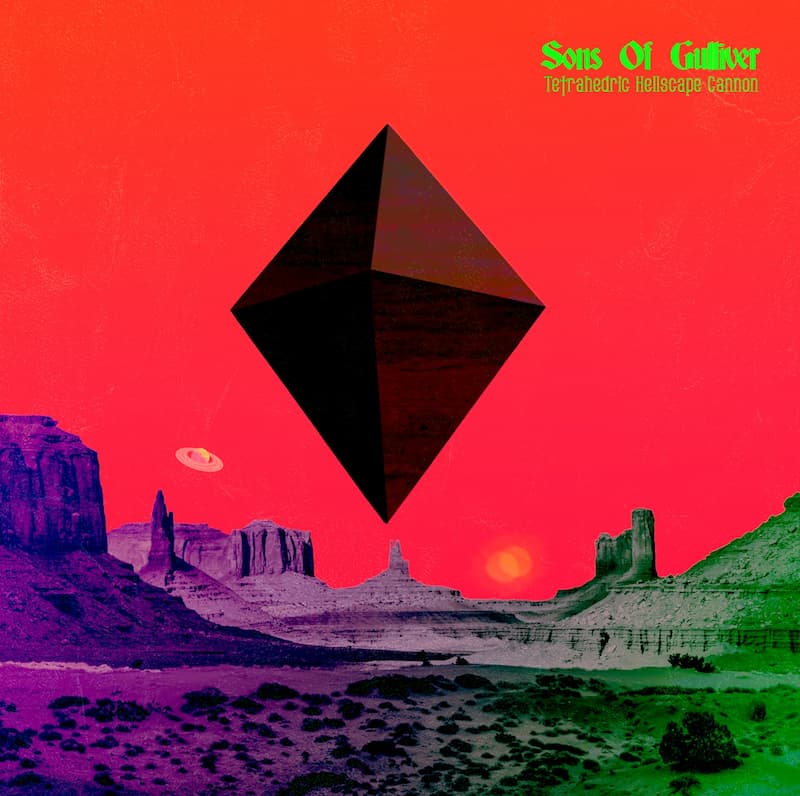
Tetrahedric Hellscape Cannon me parece una obra maestra. Cada escucha me convence más. Los dos han cuidado todos los detalles. Desde el rollo cinematográfico que se escucha y se ve en los videoclips que Dolphin se ha currado, el artwork, con esa sinestesia evidente en los colores que plantea Justin, hasta los temas instrumentales.
I’m just going to say it: Tetrahedric Hellscape Cannon is one helluva record. Every listen pulls me in a little deeper. Every detail feels fought for. From the cinematic edge you get in Dolphin’s videos, to the artwork and the synesthetic colors Justin sees in the sound, to the instrumental pieces that make the record the masterpiece it is.
El primer tema “FTS” (fuçk this sh!t) es guapísimo. Y una forma muy inteligente de abrir el disco. El outro “End Transmission”, con ese guiño instrumental que rescata un riff de “Distorsion or Death”, cierra el círculo con un aire muy Monster Magnet. Y por fin la voz me encaja más. Más adecuada. Más consciente de su sitio.
“FTS” (fuçk this sh!t) is a killer opener. It’s bold, smart and sets the tone without overexplaining. The closer, “End Transmission”, with its Monster Magnet aura, circles back with an instrumental nod to “Distorsion or Death”. And the vocals? They finally start to click for me. They’re more grounded and more aware of their role. Less forced.
La intro de “Dunes” es de lo mejorcito del álbum. “Vagabonds”, con esos graves sucios, casi nasty, me parece adictiva.
“Dunes” kicks in and you’re locked. “Vagabonds,” with those dirty, almost nasty, bass lines, is addictive.
Y luego está “Earthbound”. Colocada justo en mitad del álbum. Nada es casual. Suena más hippie, más trippy de lo que esperarías de Dolphin, y tiene explicación: Justin la compuso con unos 16 años para su primera banda. Aquí Dolphin toca la conga y Jimbo Hart la guitarra. Es instrumental. Muy DunaJam. Y añade una textura cinematográfica que expande el disco hacia otro plano.
Es preciosa. Y sí, hay mucho psicodélico instrumental aquí. Pero yo necesito moverme. Si has estado en un bolo conmigo, lo sabes: bailo todo: heavy, metal, grindcore, stoner, garage. Y este disco es bailable de principio a fin.
Sons of Gulliver son reyes del groove. Y del breakdown. Escucha “THC” y “Headcleaner” y luego me cuentas.
And then there’s “Earthbound,” the instrumental track placed right at the center. Nothing here feels accidental. It’s more hippie, more “trippy” than you’d expect from Dolphin. But there’s a reason for that. Justin wrote it when he was about sixteen for his first band. Here, Dolphin plays the conga and Justin’s brother, producer Jimbo Hart, steps in on guitar. It has a kind of “DunaJam vibe” and it expands the record into something more cinematic, more spacious.
It’s gorgeous, much like a lot of the instrumental-psych-feel floating around this album. But I need to move. If you’ve ever been to a show with me, you know I dance to everything – heavy, metal, grindcore, stoner, garage… This record? It definitely gets you moving.
Sons of Gulliver are masters of the groove and the breakdown. Just put on “THC” and “Headcleaner”, and then get back to me.
Ahora bien: el único tema que no me ha terminado de volar la cabeza es “Headcleaner”. No sé si porque se aleja un poco del rock and roll más puro, o por la voz. Es un buen tema – los riffs son muy “Bulls on Parade”, el breakdown funciona y el final es una PASADA – pero lo admito: tengo una obsesión con las voces. Justin va encontrando la suya, sí. Pero el reverb aquí no me encanta.
La voz es un instrumento. Y como dice Dolphin, “una buena voz humana es lo mejor que hay”. Pero tiene que encajar. No quiero un sitar en mitad de thrash. Por eso nunca he conectado del todo con Jethro Tull (ni con sus clones españoles Ñu), por muy brillantes que sean. Tampoco me entusiasma la guitarra en el jazz. Ni George Benson ni Pat Metheny. Lo siento.
En “Headcleaner”, quizá habría descartado los tres primeros minutos, dejándolo como un tema instrumental. Es solo una opinión. Lo dicho, la base es sólida. Y viniendo de alguien que se autodenominaba “loser” (el proyecto anterior de Dolphin se llamaba Downtown Losers”) y de un millennial de Alabama, territorio orgullosamente “redneck”, el resultado sigue siendo notablemente inteligente.
That said, “Headcleaner” is the only track that didn’t completely blow me away. I’m not sure if it’s because it drifts slightly away from the rawer “rock and roll” core, or because of the voice. Don’t get me wrong, it’s a solid song. The riffs have serious “Bulls on Parade” DNA, the breakdown melts your face, the ending is massive… but I’ll admit it: I have a “thing” with voices. Justin is finding his. But the reverb here? Not exactly loving it.
We sometimes overlook the fact that the voice is an instrument. And as Dolphin likes to say, “a good human voice is the best thing there is.” But it has to belong. I don’t want to hear a sitar in the middle of thrash metal. That’s why I’ve never fully connected with Jethro Tull (or their Spanish clones, Ñu), no matter how good they might be. I’m not wild about guitar in jazz either (sorry George Benson, sorry Pat Metheny).
If it were up to me, I probably would’ve disregarded the first three minutes of “Headcleaner” and left it instrumental. But, hey. That’s just me. Like I said, it’s a solid track. And considering that all this comes from a guy who once fronted a project called Downtown LOSERS and a millennial from proudly redneck Alabama, the end result is amusingly “smart”.
Así es el disco: inteligente y lleno de influencias. El otro día vi un reel de otro todopodero, Zakk Wylde, explicando cómo “Miracle Man” para Ozzy era básicamente “Foxy Lady” pasada por su filtro. Decía algo así como que todo lo que aprendes se convierte en ingredientes. Lo doblas, lo retuerces, lo haces tuyo. Aunque no siempre seas consciente.
En Tetrahedric Hellscape Cannon las influencias están. (Sí… lo sé… tengo un problema con las asociaciones.) Además de RATM y Monster Magnet, percibo ecos de los cruces que hizo Tom Morello en pandemia. Esos graves que me recuerdan a “Rabbit’s Revenge”, aquella colaboración con Bassnectar, Big Boi y Killer Mike. Y los riffs de “THC” me traen a la cabeza “Electric Carve” de 1000mods (aunque sospecho que Justin probablemente no tenga ni idea de quiénes son porque si es un estadounidense de verdad, quizá ni sepa que Grecia existe).
Detalle curioso: “THC” se grabó en Muscle Shoals con el resto del disco, pero luego rehicieron las voces de Justin en casa de Dolphin. Y eso me encanta. Esa mezcla entre estudio mítico y salón de tu casa.
In fact, that’s another label we can use for this album: Smart. And layered with influences. I saw a reel recently where another one of my “gods”, Zakk Wylde, was talking about how “Foxy Lady” inspired him when he wrote “Miracle Man” for Ozzy. Basically he said that everything you take in becomes an ingredient. You just bend it, twist it and make it yours – sometimes without even realizing it.
You can hear influences like that all over Tetrahedric Hellscape Cannon. (Yeah, I know… I have a problem. I can’t help associating licks, hooks and riffs with other songs.) Beyond the obvious RATM and Monster Magnet threads, some of the low-end textures take me back to the pandemic experiments Tom Morello was putting out (for example, “Rabbit’s Revenge” with Bassnectar, Big Boi and Killer Mike). And the riffs on “THC” remind me of “Electric Carve” by my favorite Greek rockers, 1000mods (although if Justin is a good American, he probably doesn’t even know Greek rock exists).
Fun fact: “THC” was tracked at Muscle Shoals with the rest of the record, but Justin’s vocals were re-recorded later at Dolphin’s house. I love that: legendary studio meets living room.
No, Tetrahedric Hellscape Cannon no es el típico disco de heavy al uso. Mucho del disco fue improvisado (algo poco habitual en terrenos “heavy”) y fue grabado en Muscle Shoals. No hay vikingos ni hadas. Hay incluso una versión contundente de “Ohio” de Neil Young. Sí, política en un disco que suena heavy. Qué cosas.
Es sencillo. Dos instrumentos y mucho groove. Y funciona.