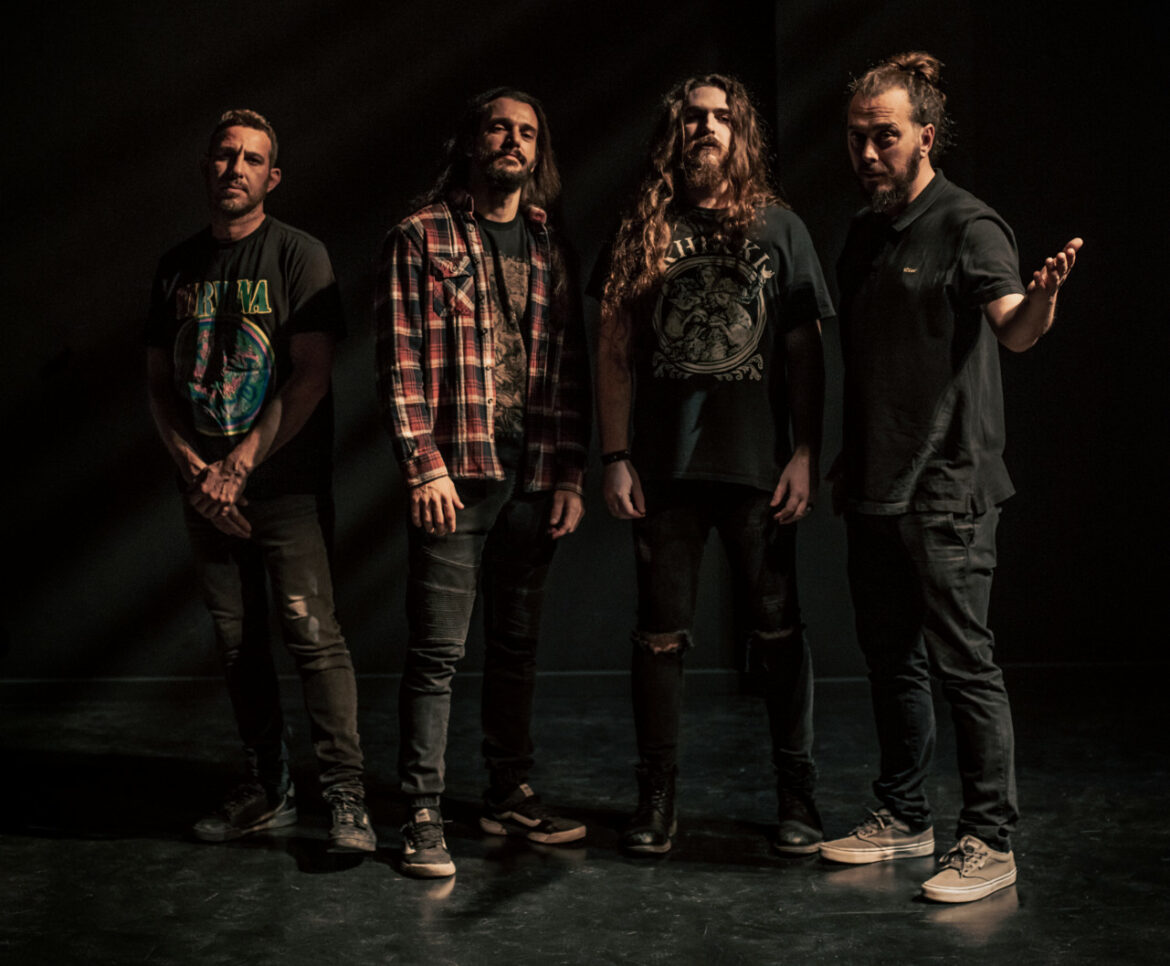
Hidden In The Basement llevan el tiempo suficiente en esto como para tener muy claro quiénes son… y, sobre todo, quiénes no. Formado en Larisa (Grecia) en 2007, el cuarteto ha pasado casi dos décadas construyendo su sitio al margen de modas, purismos de género y atajos comerciales. Ahora con su actual lineup, Kostas Tsiavalias (guitarra y voz), Christos Mitros (guitarra), Filippos Zoukas (bajo y voz) y Thanos Dimkos (batería) publicaron Mud Days, su cuarto larga duración. Suena a una banda asentada, más pesada, más afilada y más consciente de lo que está haciendo que nunca.
Hidden In The Basement have been around long enough to know exactly who they are – and, just as importantly, who they’re not. Formed in Larisa, Greece in 2007, the quartet have spent close to two decades carving out a space far from hype cycles, genre purism or commercial shortcuts. With their current lineup, Kostas Tsiavalias (guitar and vocals), Christos Mitros (guitar), Filippos Zoukas (bass and vocals) and Thanos Dimkos (drums) just put out their fourth full-length album, Mud Days. With this newest release, Hidden in the Basement sound like a band fully settled into its own skin: heavier, sharper, and more self-aware than ever.
REVIEW/RESEÑA MUD DAYS: https://www.dirtyrock.info/2026/01/hidden-in-the-basemetn-mud-days
En Dirty Rock Magazine, llevamos años con una especie de fijación con las bandas griegas y, a estas alturas, sigue sin entrarnos en la cabeza que no tengan mucha más visibilidad fuera de su país. En algún momento, Grecia dejó de ser un país de dioses clásicos para convertirse en riffs llenos de fuzz, colmillo social y una escena underground con carácter propio.
hay muchísimos músicos con talento [en Grecia], y la influencia entre bandas es tan fuerte que nos empuja a seguir escribiendo cada vez mejor música
Hay una lista larga de nombres sistemáticamente ignorados que han cambiado por completo nuestra forma de escuchar ese contexto. Para un público español (o cualquier otro con temperamento mediterráneo) debería resultar familiar, pero los griegos saben decir las cosas con menos complacencia, más filo y una urgencia que aquí, en demasiados casos, hemos preferido apartar a un lado.
At Dirty Rock Magazine, we’ve developed a bit of an ongoing obsession with Greek bands over the years and honestly, we’re still baffled that more people aren’t paying attention. Somewhere along the way, Greece stopped being just a land of ancient gods and started meaning fuzzed-out riffs, social bite and a heavy underground scene with its own personality.
A long list of criminally overlooked names have reshaped how we hear that scene. For a Spanish audience (or any other crowd with a Mediterranean temperament), it ought to feel close, although the Greeks know how to deliver their messages with sharper edges, less complacency, and a sense of urgency we’ve largely talked ourselves out of.
MORE ON THE GREEK SCENE at Dirty Rock Magazine: https://www.dirtyrock.info/2023/03/the-new-greek-gods-and-goddessess
MÁS BANDAS GRIEGAS en Dirty Rock Magazine: https://www.dirtyrock.info/2023/03/los-nuevos-dioses-y-diosas-de-grecia/
Hidden In The Basement encajan ahí de forma natural, pero no están colgados de ninguna ola ni viviendo del relato de escena. Lo suyo se ha construido con tiempo y con intención. Del metal alternativo experimental (bien ejecutado) de Ego (2013) pasaron a Behind The Shadow (2016), un disco lleno de inquietud interior que va de momentos densos a estallidos de ruptura. Nada de esto está pensado para entrar fácil ni terminar limpio y bonito.
La tele debería ir directamente por la ventana… [lo que vemos] nos cabrea bastante, y por eso muchas de nuestras canciones tienen un trasfondo social y hablan de los problemas de la sociedad en la que vivimos.
Esa misma forma de entender la música es la que les ha dado una reputación sólida en directo, a base de girar sin descanso por Grecia, Europa y Turquía, y de compartir escenario con bandas como Sepultura, Clutch, Orange Goblin, Rotting Christ o Karma to Burn. Sin épica ni mitología: volumen, presencia y peso.
Hidden In The Basement fit naturally into that lineage, but they’re not surfing a trend or leaning on a scene narrative. Over the years, they’ve built their identity through steady, deliberate steps. From the experimental (yet tightly executed) alternative metal of Ego (2013) to Behind The Shadow (2016), an album full of inner unrest that alternates between slow-burns and breaking points, their work has consistently resisted easy digestion or neat conclusions.
That same attitude has shaped their reputation as a live band, earned through relentless touring across Greece, Europe, and Turkey, and by sharing stages with acts like Sepultura, Clutch, Orange Goblin, Rotting Christ and Karma to Burn. No mythology, no shortcuts – just volume, stage presence, and weight.
El problema no son los formatos ni los canales de distribución, sino el enfoque social hacia la música, que se ha ido degradando en los últimos años.
Mud Days suena a resumen de todo ese camino. Se mueve entre el hard rock, el metal alternativo, el stoner y una pesadez con aroma southern, equilibrando riffs densos y físicos con una atención mayor a la melodía y al contraste. Las voces limpias y las más agresivas se cruzan sin competir, como parte del mismo discurso. Hay ecos claros del Palm Desert de los 90, pero pasados por un filtro actual y abrasivo, marcado por el cabreo con lo que hay fuera, la lealtad a lo que ocurre dentro de la banda y la idea de que la música pesada todavía no ha dicho ni mucho menos su última palabra.
Mud Days feels like a distillation of all that experience. Sitting somewhere between hard rock, alternative metal, stoner, and southern-tinged heaviness, the album balances dense, physical riffs with a renewed focus on melody and contrast, letting clean and harsh vocals collide naturally rather than fight for space. There’s a clear nod to the ’90s Palm Desert ethos, but filtered through a modern, abrasive lens shaped by frustration with the world outside, commitment to what happens inside the band, and the belief that heavy music still has unexplored ground left to burn.
La composición es una forma de convertir pensamientos y emociones en sonido y de comunicarnos con quien escucha.
Que Hidden In The Basement se pusieran en contacto con nosotros para esta entrevista fue un honor. Que además lo hicieran con respuestas pensadas, directas y sin piloto automático, todavía más. Nada de frases prefabricadas ni respuestas intercambiables: aquí hay reflexión, criterio y una forma muy clara de entender por qué seguir haciendo las cosas por el camino difícil sigue teniendo sentido. Más que una entrevista al uso, esto acabó siendo una conversación con una banda que sabe lo que dice… y por qué lo dice.
Gracias, Hidden In The Basement. A ver si la próxima es con vosotros sobre un escenario en España.
We were genuinely honored that Hidden In The Basement reached out to us for this interview—and even more so by the depth of their answers. No copy-paste platitudes, no default responses: just thoughtful, direct reflections on music, society, longevity, and why doing things the hard way still matters. This conversation felt less like ticking off interview questions and more like an exchange with a band that actually has something to say – and means it.
Thank you, Hidden in the Basement. Hope to see you in Spain soon!
texto: Ángel Manuel Hernández Montes / je55iejay
ENTREVISTA A HIDDEN BASEMENT:
FULL INTERVIEW IN ENGLISH below
DIRTY ROCK: Mirando atrás, después de casi dos décadas como banda, se nota claramente una evolución en vuestro sonido. ¿Diríais que Mud Days marca un punto de inflexión para Hidden In The Basement?
HIDDEN IN THE BASEMENT: Arrancamos en 2007, así que sí, llevamos casi dos décadas dando guerra. Si escuchas del primer disco al último, el cambio y la evolución se notan bastante. Creemos que Mud Days es nuestra versión más completa y madura hasta ahora. ¿Si es un punto de inflexión? Eso lo dirán el tiempo y nuestro público.
DIRTY ROCK: Si no estamos equivocados, habéis mantenido prácticamente la formación original. Si es así, ¿cómo de complicado es mantener una visión común durante tantos años y seguir sacando música tan interesante?
HIDDEN IN THE BASEMENT: Eso es cierto… en un 75 %. A día de hoy seguimos siendo 3 de los 4 miembros originales. Hemos cambiado dos veces al guitarrista rítmico, y Christos Mitros, que ocupa ahora ese puesto, está en la banda desde 2020.
Lo complicado es mantener la visión en medio de la rutina diaria y de los problemas que te va poniendo la vida delante. Para nosotros, la banda y componer música son una vía de escape, así que volcamos ahí toda nuestra energía y nuestras ganas. Y eso, creemos, se nota en las canciones.
DIRTY ROCK: Soléis dejar pasar tiempo entre discos: tres años parece vuestro ritmo natural. Da la sensación de que es una decisión consciente, trabajar sin prisas y sacar el disco cuando todo está realmente cerrado. ¿Es así?
HIDDEN IN THE BASEMENT: Creemos que dos o tres años entre discos es un buen margen. Solo entre Cursed by the Sun (2019) y Mud Days (2025) hubo un parón más largo, primero por el COVID y luego por otros contratiempos.
No tenemos prisa ni con los discos ni con la composición. Cuando sentimos que algo está listo, lo sacamos al 100 %, para que quien lo escuche pueda disfrutarlo al máximo.
DIRTY ROCK: En los últimos años ha habido una explosión bastante clara de bandas griegas de stoner, metal y heavy, con muchísimo nivel. ¿Dónde os situáis dentro de ese contexto y cómo veis el estado actual del rock griego, dentro y fuera del país?
HIDDEN IN THE BASEMENT: Han salido muchas bandas griegas muy buenas en estos géneros durante los últimos años. Todo este crecimiento de la escena de rock y metal en Grecia ha ayudado a que se empiece a hablar más de ella primero en Europa y luego a nivel internacional.
Con el tiempo, la banda se ha acabado considerando parte de esa escena, y nosotros intentamos aportar lo nuestro con nuestra presencia y con nuestra música para que siga creciendo.
DIRTY ROCK: Hay países que parecen producir músicos increíbles de forma casi sistemática. El otro día hablábamos en Dirty Rock de la cantidad de bandas escandinavas brutales que hay y, desde nuestra ignorancia, pensamos que igual el clima influye: más tiempo en casa, más horas componiendo. Grecia tiene un clima y una forma de vivir parecida a la de España, así que esa teoría no cuadra. ¿Por qué crees que sale tanto buen arte de Grecia? Es el tzatziki? 😛
HIDDEN IN THE BASEMENT: Es verdad lo de los músicos escandinavos. Leí una entrevista al guitarrista de In Flames en la que le preguntaban cómo podían escribir música tan buena, y él decía que pasan todo el día en casa, así que tienen más tiempo para la música.
En nuestro caso es justo lo contrario. Somos mediterráneos, como vosotros, así que estamos todo el día en la calle. Creo que simplemente es algo natural: hay muchísimos músicos con talento aquí, y la influencia entre bandas es tan fuerte que nos empuja a seguir escribiendo cada vez mejor música. Eso ha hecho que aparezcan muchas bandas nuevas y que el nivel de la escena sea muy alto. Eso sí, el tzatziki y el tsipouro distraen bastante jaja
DIRTY ROCK: Cuando encendéis la tele y veis las noticias, ¿os entran ganas de escribir una canción… o de tirar el televisor por la ventana?
HIDDEN IN THE BASEMENT: Las dos cosas. La tele debería ir directamente por la ventana: es una herramienta de lavado de cerebro masivo, y las noticias son lo peor, siempre intentando manipular la opinión pública según lo que les conviene.
Todo eso nos cabrea bastante, y por eso muchas de nuestras canciones tienen un trasfondo social y hablan de los problemas de la sociedad en la que vivimos.
DIRTY ROCK: En este último disco parece que hay un equilibrio muy claro entre riffs y solos, con un peso importante de la melodía. ¿Habéis encontrado una forma natural de juntar pegada rítmica y profundidad melódica?
HIDDEN IN THE BASEMENT: Siempre hemos sido una banda muy basada en riffs. En Mud Days pusimos más énfasis en las melodías y en los solos, con un enfoque más maduro, para que estuvieran al mismo nivel que los riffs. Ese era el concepto durante la composición del disco, y nos alegra que lo hayáis percibido.
DIRTY ROCK: Damos por hecho que el hard rock clásico y el heavy de los 80 forman parte de vuestro ADN. Para no caer en comparaciones obvias y mantener vuestra identidad, ¿qué otras influencias, musicales o no, entran en vuestro proceso de composición?
HIDDEN IN THE BASEMENT: Cada uno de nosotros tiene influencias musicales distintas, y creemos que esa diversidad es clave en nuestro sonido. Hidden in the Basement son cuatro personas muy diferentes, cada una aportando su propia visión.
Más allá de la música, las experiencias del día a día también pesan mucho a la hora de componer. La composición es una forma de convertir pensamientos y emociones en sonido y de comunicarnos con quien escucha. A medida que nosotros cambiamos y evolucionamos con los años, la música también lo hace.
DIRTY ROCK: Con la cantidad de música que se publica hoy, ¿sentís que todavía hay espacio para hacer algo realmente nuevo?
HIDDEN IN THE BASEMENT: En 2026, hay infinitas formas de enfocar el sonido y la producción. Cada artista acaba eligiendo una, o mezclando varias, para expresar lo más claramente posible lo que tiene en la cabeza.
Cuando alguien se implica al 100 % en lo que crea, aunque la estética o el sonido lo sitúen dentro de un género concreto, el resultado sigue siendo algo nuevo, porque lleva impresa la personalidad de quien lo hace.
Además, creemos que el sonido y sus posibilidades creativas todavía no se han explorado del todo. Por eso siempre habrá margen para hacer cosas nuevas, incluso en la forma en que percibimos y experimentamos la música.
DIRTY ROCK: Cuando se habla de bandas nuevas, a menudo da la sensación de que faltan canciones en el sentido clásico del término: composiciones completas, himnos atemporales tipo “Stairway to Heaven”, “Paranoid” o “Number of the Beast”. Sabemos que todo va más rápido ahora, pero ¿crees que esa creatividad duradera es más difícil de encontrar hoy? ¿Dónde están los himnos universales actuales?
HIDDEN IN THE BASEMENT: Para nosotros, cada himno atemporal representa una época entera, no solo una buena canción. Se siguieron escribiendo himnos en los 90, en los 2000 y en los 2010, y se siguen escribiendo hoy, siempre reflejando el momento en el que nacen y las preocupaciones de esa época.
Bandas como Nirvana, Pearl Jam, Slipknot y muchas otras marcaron profundamente su tiempo y a la gente que las escuchó.
También tendemos a llamar himnos atemporales a canciones que tienen 30 o 40 años, así que quizá lo que hace falta es darle a la música actual ese mismo margen de tiempo antes de decidir qué canciones van a resistir de verdad.
DIRTY ROCK: ¿La accesibilidad total a la música es realmente algo positivo? Da la sensación de que apenas hay tiempo para digerir un disco antes de pasar al siguiente. ¿Estamos escuchando música o simplemente consumiéndola?
HIDDEN IN THE BASEMENT: El acceso masivo a la música, en general, es algo positivo. Permite buscar, escuchar y ampliar horizontes, algo que antes era mucho más complicado.
El problema está en el sistema en el que vivimos y en cómo se trata la música —y el arte en general— dentro de él. Cuando todo se reduce a producir para consumir y cobrar, el sentido real de la música se pierde.
Si el objetivo es crear compradores en lugar de oyentes con criterio propio, acabamos consumiendo sin escuchar de verdad.
El problema no son los formatos ni los canales de distribución, sino el enfoque social hacia la música, que se ha ido degradando en los últimos años.
DIRTY ROCK: ¿Compagináis la banda con otros trabajos o habéis conseguido vivir solo de la música?
HIDDEN IN THE BASEMENT: Además de Hidden in the Basement, todos tenemos otros trabajos. Por desgracia, hoy en día —y más en el estilo que tocamos— es muy difícil llegar a vivir exclusivamente de la música. Así que equilibramos nuestros trabajos diarios con la banda, por complicado que sea.
DIRTY ROCK: Para cerrar: con el nuevo disco ya fuera, lo lógico es llevarlo al directo. ¿España está en vuestros planes?
HIDDEN IN THE BASEMENT: Ahora mismo, por desgracia, no hay planes para tocar en España. Aun así, siempre estamos abiertos a nuevas propuestas y con ganas de tocar en sitios en los que nunca hemos estado.
DIRTY ROCK: Gracias otra vez por vuestro tiempo y por esta charla. Tenemos muchas ganas de veros en directo pronto.
HIDDEN IN THE BASEMENT: ¡Gracias a Dirty Rock Magazine por contar con nosotros! ¡Ojalá podamos tocar en España muy pronto!
INTERVIEW WITH HIDDEN BASEMENT:
DIRTY ROCK: Looking back over two decades as a band, there’s a clear evolution in your sound. Would you say Mud Days represents a turning point for the band?
HIDDEN IN THE BASEMENT: We started the band in 2007, so yes we’ve been around for almost 2 decades! Over the years and from the first to the latest album, the change and evolution in our sound is quite noticeable. We think that Mud days represents our most complete and mature self, about whether it is considered a turning point for the band, time and audience will tell!
DIRTY ROCK: If we’re not mistaken, Hidden In The Basement has kept its original lineup. If so, how hard is it to maintain a shared vision during so many years and still come up with music as interesting as yours?
HIDDEN IN THE BASEMENT: That is about 75% correct! Till today we are 3/4 the original members, we have changed 2 members in the rhythm guitar, and Christos Mitros that has that duty now, is in the band from 2020.
The hard part is to maintain the vision through the daily routine and life’s problems that will come up, for us the band and writing music is a getaway from all this, so we put all our excitement and interest in that effort, and you can see that interest through our music.
DIRTY ROCK: You tend to take your time between albums, three years seems to be your sweet spot. It feels like a conscious choice: working at your own pace, making sure everything is fully developed before putting it out so the listener can really enjoy it… Is that the case?
HIDDEN IN THE BASEMENT: We think that 2-3 years is a good gap between albums. Only between Cursed by the sun (2019) and Mud Days (2025) we had that big gap, firstly because of covid, and from some other setbacks
We are not rushing our albums or the composition procedure, whenever we feel ready, we release our music to its 100%, so the listener can enjoy the result to its ultimate form.
DIRTY ROCK: In recent years, we’ve seen a pretty big surge in Greek stoner, metal and heavy bands – so many really great artists! Where do you see yourselves within that context, and how do you view Greek rock as a whole in today’s heavy rock and alternative metal scene both locally and internationally?
HIDDEN IN THE BASEMENT: There are many great greek bands that emerged during the last years in those genres. All this ascent of greek rock and metal scene, has certainly helped the scene to arise firstly in Europe, and internationally. The band over the years is considered to be a part of that scene, and we try our best with our presence and our music all these years to make the scene even greater!
DIRTY ROCK: Some countries seem to produce great musicians. The other day a couple of us in the Dirty Rock team were talking about how there seems to be so many great Scandinavian musicians, and we decided (in all our ignorance) that maybe the climate has to do with it: they spend more time inside, composing, creating, hanging out, etc. Greece has a similar climate and culture to Spain, we’re out in the streets all the time so that can’t be your reason. Why do you think so much great art comes from Greece? … is it the Tzatziki? 😛
HIDDEN IN THE BASEMENT: That is true about Scandinavian musicians, I have read an interview of the guitarist of In Flames, and the question was how can they write so great music, the answer was that they are all day inside, so they have more time for music! In our case is quite the opposite! We are Mediterranean people like you guys, so yes, we are out all the time! I think that it comes natural, there are many talented musicians here, and the influence between bands is so big, that we want to keep writing more and more good music. As a result, more new bands emerging from nowhere, and the level in the scene and the music is really high. Tzatziki and tsipouro is a serious distraction though!
DIRTY ROCK: When you turn on the TV and watch the news, does it make you want to write a song… or throw the TV out the window? (or maybe a different urge?)
HIDDEN IN THE BASEMENT: Both. TV must be thrown out of the window anyways, it’s a tool for brainwashing the masses, and news is the worst thing you can see, trying to manipulate the public opinion in any way that fits for them. This whole situation enrage us, and that’s why many of our songs have a social background and talk about our society problems.
DIRTY ROCK: On this latest record, it feels like you’ve given equal weight to riffs and guitar solos, with a clear focus on melody. Have you found a way to make rhythmic punch and melodic depth coexist naturally?
HIDDEN IN THE BASEMENT: Always our songs were more guitar riff-based. In Mud Days there was more focus in melodies and guitar solos with a more mature approach, so that they will be equal to the guitar riffs in the album. That was the concept when we were composing the album, and we are glad that you noticed it!
DIRTY ROCK: We assume classic hard rock and ‘80s heavy rock bands are part of your background. To avoid falling into obvious comparisons and to keep your own identity intact, what other influences (musical or otherwise) feed into your songwriting?
Our musical influences differ from one another, and we believe that this diversity is a key element in shaping our sound. Hidden in the Basement is a band made up of four very different individuals, each bringing their own perspective into the mix.
HIDDEN IN THE BASEMENT: Beyond musical influences, our everyday experiences also play a crucial role in the songwriting process. Composition becomes a way for us to transform our thoughts and emotions into sound, and through that, to communicate with our listeners. As we grow and evolve as people over the years, the music we create evolves alongside us.
DIRTY ROCK: Your approach clearly sits outside the traditional hard rock and heavy metal rulebook. With so much music being released today, do you still feel there’s room to do something genuinely new?
HIDDEN IN THE BASEMENT: In 2026, there are countless sonic and production approaches available for musical expression. Every artist who chooses to walk this path ends up selecting one, οr blending several, of these approaches in order to express as clearly as possible what they have in mind and want to communicate.
When an artist commits 100% of themselves to what they create, even if the production aesthetics or sonic characteristics place it within a certain genre, the result is still genuinely new because it carries the uniqueness of that individual.
Beyond that, we truly believe that sound itself and its creative possibilities have not been fully explored. For that reason, there will always be room to create something new, even in terms of how we perceive and experience sound.
DIRTY ROCK: When it comes to newer bands, there often seems to be a lack of songs—and by songs we mean fully formed compositions, timeless anthems like “Stairway to Heaven,” “Paranoid,” or “Number of the Beast.” We know times have changed and everything moves faster now, but do you think that kind of long-lasting creativity feels harder to find today? Where are today’s universal “anthems”?
HIDDEN IN THE BASEMENT: In our view, every timeless anthem ever written represents and reflects an entire era, not just a strong composition. Anthem songs continued to be written throughout the ’90s, the 2000s, and the 2010s, and they are still being written today—always mirroring the time they were created in and the concerns of that specific period.
Bands such as Nirvana, Pearl Jam, Slipknot, and many others left a lasting mark on their respective eras, as well as on the people who listened to them.
We also tend to define timeless anthems as songs that are 30 or 40 years old, so perhaps what we really need is to give today’s music the same amount of time before deciding which songs will truly stand the test of time.
DIRTY ROCK: Is total accessibility to music really a good thing? It often feels like you barely have time to absorb one album before moving on to the next. Are we listening to music… or just consuming it?
HIDDEN IN THE BASEMENT: Mass accessibility to music, in a broad sense, is a good thing. It allows people to search, listen, and expand their musical perspective, something that used to be much more difficult in the past.
The real issue lies in the system we live in and in the way music, like all forms of art, is treated within it. When the approach becomes producing in order to be consumed, and ultimately to be paid, the true meaning of music is lost.
Furthermore, when the goal is to create consumers who buy rather than listeners with a personal viewpoint, we inevitably end up consuming without truly listening.
The problem is not the mediums through which music is distributed, but the social approach toward music, one that has been deteriorating over the past years.
DIRTY ROCK: Do you balance music with day jobs, or have you managed to make a living solely from the band?
HIDDEN IN THE BASEMENT: Besides Hidden in the Basement, we all have other professions as well. Unfortunately, being a musician nowadays, especially in the genre we play, makes it very difficult to reach a point where you can make a living solely from music. As a result, we balance our everyday jobs alongside our commitment to Hidden in the Basement, no matter how challenging that may be.
DIRTY ROCK: To wrap things up: now that the new album is out, we assume the next step is taking it to the stage. Is Spain on your radar?
HIDDEN IN THE BASEMENT: At the moment, there are unfortunately no plans to visit Spain. However, we are always open to new proposals and excited about the possibility of playing in places we’ve never been before.
DIRTY ROCK: Thanks again for your time and what we’re sure will be a great conversation. We’re really looking forward to seeing you live soon!
HIDDEN IN THE BASEMENT: Thank you for having us in Dirty rock Magazine! We are looking forward to perfom at Spain as soon as possible!
