
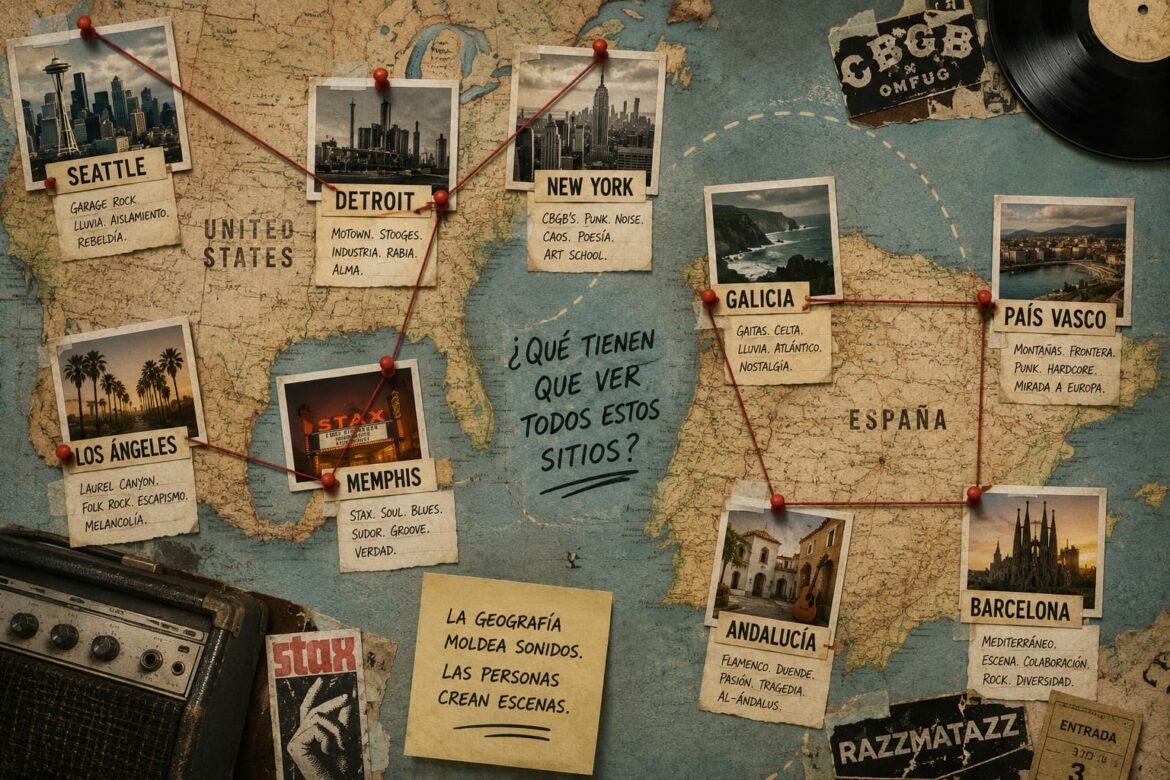
La geografía no solo importa en la música. La geografía lo es todo. De hecho, probablemente sea el miembro olvidado de casi cualquier banda.
En Estados Unidos llevamos más de un siglo comprobándolo. Primero estaban los trovadores del sur, sentados en los porches o tocando blues en los juke joints con una guitarra o armónica entre las manos. Después llegaron los chavales del norte, enchufaron esas mismas guitarras a un ampli y cambiaron las reglas del juego. Más tarde, guitarristas más enfocados en la técnica se juntaron con otros músicos y transformaron el blues en una fiesta.
Por eso no hablamos simplemente del “blues”. Hablamos de Delta blues, Chicago blues, Texas blues…
Geography isn’t just important in music. Geography is everything. It’s actually the forgotten member of most every band.
In the US we’ve seen it for a century now: troubadour OGs in the south on their porches and in juke joints singing the blues and picking at their guitars before the boys up north electrified it, or the more technically-minded guitarists from Texas teamed up with a bunch of other musicians, turning the blues into a party…
These days, we don’t just talk about “the blues”. We say “Delta blues”, “Chicago blues”, “Texas blues”…
Sí, la geografía importa.
Y si pudieras viajar a Estados Unidos en 1967, lo entenderías enseguida.
Geography matters.
In fact, if you could time travel back to 1967 in the USA, you would see just how much.
Empieza por el gris noroeste del Pacífico. Ciudades portuarias aisladas como Seattle o Tacoma, en el estado de Washington. Chavales aburridos, de clase trabajadora, con guitarras baratas y una idea muy sencilla: tocar rápido, tocar alto y no preocuparse demasiado por cómo sonaba aquello en el estudio.
The Sonics, The Wailers o The Kingsmen plantaron una semilla enorme. Si aceleras a The Sonics, son los Ramones. Si los enfadas, aparece Iggy Pop. Si les das un toque más poético o “cerebral”, aparece Patti Smith. Estas bandas demostraron que no hace falta ser un virtuoso para resultar importante. Basta con tener un amplificador.
Start out in the rainy, gray Pacific Northwest with bored kids in working-class, completely isolated port towns like Seattle and Tacoma (Washington), playing cheap guitars and coming up with their own rulebook: play fast, play loud, and don’t give a damn about production.
Bands like the Sonics, the Wailers and the Kingsmen planted an important seed. If you speed up the Sonics, you get the Ramones. If you make them angry, you get Iggy. If you give them a poet’s brain, you get Patti Smith. These bands proved that you don’t need virtuosity to be vital. You just need amps.
Pero esos amplis nunca suenan igual en todos los sitios.
Teletranspórtate hacia el este, cruza el lago Míchigan y aterriza en Detroit. Una ciudad moldeada durante décadas por la segregación, la brutalidad policial y la desigualdad económica. En julio de 1967 todo estalló. Una redada en un bar sin licencia desencadenó cinco días de disturbios que dejaron 43 muertos y más de dos mil edificios destruidos.
Aquella semana cambió Detroit para siempre. Aceleró el éxodo de población blanca y empresas hacia los suburbios, vació la ciudad de recursos y, al mismo tiempo, abrió una nueva etapa política en la ciudad, con una comunidad política afroamericana cada vez más protagonista y poderosa.
But those amps sound different depending on where they’re played.
Teletransport yourself due east, jump over Lake Michigan, and you land in Detroit. Fueled by decades of racist housing policies, police brutality and economic inequality, in July of 1967, the city was on fire – literally. A police raid on an unlicensed bar ignited five days of devastating rebellion in Detroit, leaving 43 people dead and over 2,000 buildings destroyed. One single week marked the city’s definitive turning point, triggering a mass exodus of white residents and businesses that drained Detroit’s tax base, while simultaneously birthing Black political power that would reshape the city’s identity forever.
De aquel infierno de hormigón salieron dos respuestas completamente opuestas… e igual de necesarias. Motown era la fachada de Detroit. MC5 y The Stooges eran el callejón de atrás. Iggy Pop y Wayne Kramer fueron testigos de los mismos incendios que Diana Ross o Marvin Gaye. La diferencia es que reaccionaron de formas radicalmente distintas. Motown decía: «Bailemos para olvidarnos de todo esto». Iggy parecía responder: «Prendámonos fuego nosotros también».
Porque sí, la política también importa. MC5 abrazaban un discurso revolucionario marxista envuelto en ruido y jazz. Los Stooges, en cambio, representaban el nihilismo más absoluto: sucios, caóticos y primitivos. Pero ambos dejaron un plano sobre el que construirían generaciones enteras. Sin Detroit no existirían el punk, el grunge… ni buena parte del heavy metal que hoy en día conocemos.
Out of that concrete hell, we got two completely opposite, yet equally essential, reactions. Motown was Detroit’s “front door”. MC5 and the Stooges were the city’s “back alley”. Iggy and Kramer witnessed the same street riots as Diana Ross and Marvin Gaye did, but they had a completely different reaction. Motown said, ‘Let’s dance to escape’. Iggy said, ‘Let’s set ourselves on fire to match the burning buildings’.
Because sure, politics matter, too. The MC5 were political Marxists with their revolutionary, jazz-infused noise while the Stooges were nihilists – sloppy, drugged out and primal. But they all left behind a musical blueprint: without Detroit, there’d be no punk, no grunge, no heavy metal.
Deja atrás Míchigan y baja hasta Memphis, Tennessee. Si Motown era el chico trajeado del baile de fin de curso, Stax era el tipo que estaba vendiendo whisky de estraperlo en el aparcamiento. O sea, estamos en pleno delta del Mississippi. Hace calor, hay humedad y todo huele a blues, góspel y sudor. Mientras MC5 gritaban sobre revolución, Otis Redding predicaba desde el escenario. Sam & Dave armonizaban como nadie e Isaac Hayes empezaba a inventarse ese funk cinematográfico que luego copiaría medio planeta.
Aquí la política también estaba presente. Booker T. & the M.G.’s reunían a músicos negros y blancos tocando juntos en pleno deep south. En 1967 eso ya era, por sí solo, una declaración política. Musicalmente, Stax enseñó al rock algo fundamental: había que tener groove. Sin Stax probablemente no existiría Exile on Main St. de los Rolling Stones, ni el “plastic soul” de Bowie en Young Americans, ni buena parte del funk… ni del hip hop construido décadas después sobre aquellos viejos samples de soul.
Leave Michigan behind and fly down south to Memphis, Tennessee. If Motown was the crooning prom king, Stax was the guy selling bootleg whiskey in the parking lot. This is, after all, the Mississippi Delta. It’s humid, it’s hot, and it’s steeped in the blues, gospel and sweat. While the MC5 were screaming about revolution, Otis Redding was testifying, Sam & Dave were harmonizing and Isaac Hayes was inventing cinematic, orchestral funk.
Politics matters here, too. Booker T. & the M.G.’s were black and white musicians playing together in the Deep South in 1967. That was an act of political warfare in itself. But musically, Stax taught rock music that it had to groove. It had to swing. Without Stax, there’s no Rolling Stones’ Exile on Main St., no David Bowie’s “plastic soul” inYoung Americans, no funk, and no hip-hop 70s soul samples.
Pero el “sueño americano” de los sesenta empieza a desmoronarse. Vuelve ahora a la costa oeste y deja que el olor a marihuana que baja desde Laurel Canyon te guíe hasta las quedadas informales de músicos como Joni Mitchell, Michelle Phillips, Frank Zappa, Crosby, Stills & Nash o Jackson Browne.
Aquí la geografía también lo cambia todo, porque Laurel Canyon era un lugar donde podías escapar, física y mentalmente, del caos de Los Ángeles. Las canciones protesta de los sesenta empezaban a apagarse y dejaban paso a otra cosa: introspección, melancolía y resaca emocional. Si los sesenta habían sido la fiesta, Laurel Canyon fue el día después. De ahí salieron el country rock con doctorado y el folk rock más sofisticado que ha dado Estados Unidos.
Alas, as the 1960s “American dream” collapses in on itself, hop back to the west coast and the smell of marijuana drifting down from Laurel Canyon will guide you to gatherings of musicians like Joni Mitchell, Michelle Phillips, Zappa, CSN, Jackson Browne…
Geography matters here, because the Canyon was an island. You could physically and mentally escape the chaos of the city below. The protest songs of the 60s had died, and in their place was melancholy introspection. The hangover after the 1960s party created country and folk rock with a PhD.
Quédate un par de años más en California antes de cruzar el país hasta NYC, al Bowery. Se acabaron las colinas que se ven desde Mulholland Drive. Aquí solo hay asfalto, edificios medio derruidos y ese olor a meado que parece inseparable de cualquier portal. Y, en medio de toda esa decadencia urbana, abre sus puertas un pequeño antro llamado CBGB.
Ya hemos hablado del Country, el BlueGrass y el Blues. Pero todos sabemos que CBGB no tenía absolutamente nada que ver con eso. Los Ramones tampoco iban de soul ni de revolución. Eran el latido acelerado y ansioso de Nueva York. Patti Smith, la sacerdotisa poeta del punk. Television, los intelectuales salidos de una escuela de arte. Talking Heads, los neuróticos observadores de la condición humana. Blondie, el glamour pop hecho persona.
Es verdad que CBGB no abrió hasta 1973, pero en realidad fue la reacción a todo lo que acabamos de recorrer. Los punks despreciaban Laurel Canyon. Pensaban que el soul ya no era relevante (aunque Stax y Motown solo empezaban a apagarse en aquella época). Y sí, adoraban Detroit… pero solo su lado más peligroso y nihilista. El punk neoyorquino era más rápido, más bruto y bastante más irónico.
Linger in California a couple years and then fly all the way over to NYC and the Bowery. Long gone are the hills seen from Mulholland Drive. Much like Detroit, there’s just pavement, decay, and the smell of urine in the stairwell. And in the middle of this urban rot, a tiny dive bar called CBGB’s opens its doors.
We’ve talked about Country, BlueGrass and Blues, but we all know that CBGB was none of that. The Ramones weren’t about soul or revolution, either. They were the sound of New York’s frantic, anxious heartbeat. Patti Smith, the poet-punk high priestess; Television, the art-school intellectuals, Talking Heads, the neurotic ethnographers; Blondie, the pop-savvy goddess…
CBGB’s didn’t exist until 1973 but it was the reaction to everything I’ve just described. The punks hated Laurel Canyon. They thought soul was irrelevant, even though Stax and Motown were just starting to die out. And yeah, they worshipped Detroit, but only the scary, nihilistic bits. NY punks played faster, dumber and with more irony.
Lo curioso es que, si colocas todas estas escenas sobre una línea temporal, descubres que prácticamente convivieron. Todo ocurrió en menos de una década. Y, sin embargo, cuesta encontrar movimientos musicales más distintos entre sí.
Por eso insisto tanto en la geografía.
Cuando escuchas música estadounidense de finales de los sesenta y principios de los setenta, no solo estás escuchando canciones. Estás escuchando a un continente entero discutiendo consigo mismo a través de cuatro zonas horarias.
The thing is, you put all these scenes on a timeline, and you realize they were all contemporaries. They were all within less than a 10-year window. But they couldn’t have been more different from each other.
Geography matters. When you listen to late 60s and early 70s American music, you’re not just listening to songs. You’re listening to a continent arguing with itself across four time zones.
El Seattle lluvioso y aislado inventó el garage simplemente porque aquellos chavales estaban apartados de todo lo demás. El Detroit industrial dio a luz tanto a la maquinaria de éxitos de Motown, como a la rabia de The Stooges. El Memphis pantanoso y segregado convirtió el groove de Stax en una forma de entender la música. Los que querían escapar de Los Ángeles encontraron refugio en Laurel Canyon. Y la Nueva York decadente y acelerada necesitó un sitio como CBGB porque la ciudad se estaba deshaciendo delante de sus propios ojos y la música tenía que sonar igual de nerviosa para seguirle el ritmo.
Y la historia no terminó ahí. La geografía volvió a dejar su huella pocos años después con el glam del Sunset Strip en Hollywood y el hardcore de Washington D. C. en los ochenta, el desert (stoner) rock de Palm Springs o el grunge de Seattle en los noventa.
Rainy, isolated Seattle invented the ‘garage’ sound because they were so far away from everything else. Industrial Detroit created Motown’s polished hit factory and the Stooges’ rage. Swampy, segregated Memphis created Stax’s groove. Sun-drenched, escapist L.A. created Laurel Canyon. And decaying, frantic NYC created CBGB’s because the city itself was collapsing, and the music had to be just as fast and anxious to keep up.
Geography is key, just as it was later on with Hollywood’s Sunset Strip glam and DC punk in the 80s, Palm Springs’ desert rock and Seattle grunge in the 90s…
¿Y España?
Llevo ya suficientes años viviendo aquí como para haber escuchado unas cuantas veces aquello de que España es flamenco, gaitas y rumba. Y cuanto más conozco este país, más claro tengo que la geografía lleva siglos moldeando su música.
Estados Unidos es inmenso, pero históricamente todavía lleva pañales comparado con España. El último siglo ha sido extraordinario para la música estadounidense, no hay duda. Pero el patrimonio musical español nace de algo mucho más antiguo: un territorio fracturado por montañas, bañado por dos mares, castigado por la lluvia en el norte y por el sol en el sur, situado en un cruce de civilizaciones que lleva miles de años generando mezclas culturales.
Y cada una de esas realidades físicas ha dejado una huella en la música.
So, what about Spain?
I’ve been here long enough to get my fair share of earfuls about flamenco, bagpipes and rumba to have realized that geography has been shaping Spain’s music for centuries.
The US is huge but it’s still in diapers compared to Spain historically. The last century in my native country has been monumental in terms of musical heritage, but Spain’s heritage comes from a fractured, sun-baked, rain-soaked, mountain-walled, sea-bordered collision of civilizations. And every single one of those physical realities has left its mark on the music here.
Aquí en España, todos sabemos que hace unos 2.500 años, antes incluso de la llegada de Roma, la península ibérica estaba habitada por pueblos celtas que descendieron desde el norte de Europa y se asentaron sobre todo en el oeste y el norte. Con ellos llegaron las gaitas, la percusión y esas melodías modales con ese punto melancólico que todavía hoy parecen flotar entre la niebla.
Y ahí vuelve a entrar la geografía. Las rías, las montañas frondosas, la cercanía del Atlántico… hicieron que Galicia y Asturias miraran más hacia el oeste que hacia el interior. Sus vínculos culturales estuvieron durante siglos más cerca del mundo celta que del resto de la península. De ahí nace esa melancolía tan particular, envuelta en lluvia, bruma y océano.
If you’re reading this in English, you probably need a short history recap. 2,500 years ago, before the Romans, the Iberian Peninsula was inhabited by Celtic tribes that came from the north and settled in the western and northern regions of Spain, bringing with them their bagpipes (gaitas), drums and haunting, modal melodies.
The geography – the isolation of the rías (fjord-like inlets), the rainy mountains, the proximity to the Atlantic – meant that Galicia and Asturias looked west, not east. Their cultural connections were to the Celtic fringe of Europe, creating a fog-bound, longing kind of sadness.
En el centro aparece otra realidad completamente distinta. La inmensa meseta castellana dio lugar a coplas, jotas, chotis y otras tradiciones populares marcadas por un paisaje abierto, seco y continental.
Y luego están las Islas Canarias, auténtico puente entre Europa, África y América. Desde allí partieron muchas de las expediciones hacia el Nuevo Mundo y, con el tiempo, el archipiélago fue incorporando ritmos afrocaribeños, síncopas y polirritmias que reflejan perfectamente esa posición intermedia entre varios continentes.
Pero probablemente la influencia más reconocible de la música española siga siendo otra: Al-Ándalus. Durante casi ochocientos años, gran parte de la península estuvo bajo dominio musulmán, y aquella presencia dejó una huella enorme en la música.
Los árabes trajeron consigo el oud (el antepasado directo de la guitarra), patrones rítmicos mucho más complejos y una forma de cantar llena de melismas, adornando una sola nota con microtonos que ni siquiera existen en la música occidental tradicional.
Apart from the vast, flat plateau that is the geographical heart of Spain with their melodramatic coplas and chotis, and the Canary Islands – the launching pad for the Spanish colonization of the Americas that absorbed upbeat, infectious polyrhythms that reflect that liminal space between West Africa, Europe, the Caribbean and Latin America, we have (arguably) the most stereotypical musical influence in Spain: Al-Andalus, the Islamic caliphate that ruled most of Spain for nearly 800 years.
The Moors brought with them the oud (the ancestor of the guitar), complex rhythmic patterns, and a melismatic vocal style that ornamented every note with microtones that don’t exist in the Western scale.
¿Y dónde arraigó todo aquello con más fuerza? En Andalucía. El sur también es melancólico, igual que el noroeste, pero de otra manera. Si Galicia mira al Atlántico con nostalgia, Andalucía parece mirar hacia dentro. Hay más pasión, más dramatismo, más tensión. Se escucha en el cante jondo. En ese lamento que parece doblar cada nota hasta casi romperla. En el duende.
Eso no es solo música. Eso también es geografía.
En el noroeste, la voz ancestral de Galicia y Asturias suena a un pueblo que vivió durante siglos entre lluvia, niebla y acantilados, mirando hacia un Atlántico infinito de color azul grisáceo. En el sur, el calor, los olivares, el viento que cruza desde el Sáhara por el Estrecho y siglos de resistencia siguen resonando cada vez que una cantaora estira una nota hasta hacerla temblar.
And where did this take root most deeply? Andalusia. The south of Spain. Much like the northwest’s music, the south’s music is melancholic, too – but more passionate and tragic. You hear it in the profound existential pain of the wailing and crying of the cante jondo (deep song) of flamenco: the duende (dark, transcendent soul) that makes the hair on your neck stand up.
That’s not just music. That’s geography.
In the northwest, the ancient, ethereal voice of Galicia and Asturias is the sound of a people who lived amongst rain and mist on the edge of the known world, staring out at the endless gray-blue Atlantic. In the south, the heat, the olive groves, the Sahara wind that crosses the Strait and the centuries of resistance… you can hear all of it in the way a flamenco singer bends a note until it breaks.
Si ahora volvemos al norte, pero esta vez al extremo oriental, volvemos a encontrarnos con una geografía que también condiciona. Los Pirineos llevan siglos funcionando como una muralla natural entre la península ibérica y el resto de Europa. Y tanto el País Vasco como Cataluña siempre han mantenido una relación especialmente estrecha con el resto del continente.
Ese contacto más temprano con las corrientes culturales europeas dio lugar en Cataluña a la Nova Cançó y, más adelante, a una escena rock muy permeable al rock progresivo británico y a la psicodelia estadounidense. Mientras tanto, el País Vasco acabaría convirtiéndose en la cuna de uno de los movimientos punk y hardcore más combativos de Europa.
Then, if you go back north to the eastern corner this time, you have extreme geography. The Pyrenees mountains form a wall between the Iberian Peninsula and the rest of Europe. And the Basque Country and Catalonia seem to have always had their eyes on the rest of the continent.
That early access to European musical trends gave way to the Nova Cançó (the new song movement) in Catalonia and later, rock that was heavily influenced by British prog and American psychedelia, and the Basque Country gave us punk and hardcore that was as aggressive as the Pyrenees themselves.
Pero Cataluña tampoco puede resumirse únicamente en eso. Barcelona, Valencia y las Baleares comparten otra característica que también es geografía: el Mediterráneo. Durante siglos han sido puertos abiertos culturalmente. Valencia desarrolló un folclore alegre, rítmico y muy ligado al baile, mientras que Ibiza, Mallorca y Menorca acabaron convirtiéndose en auténticos cruces de caminos donde convivían influencias muy distintas.
El resultado fue un sonido híbrido, abierto y cosmopolita que probablemente alcanzó su máxima expresión en los años ochenta con el llamado Balearic Beat, aquella mezcla despreocupada de disco, funk, soul, electrónica y ambientes chill-out que terminaría influyendo en el nacimiento de la música house.
But not everything in Catalonia is harsh. Barcelona, Valencia and the Balearic Islands have geography that’s associated with pleasure, mainly thanks to the Mediterranean Sea. Folk songs from Valencia are upbeat, rhythmic, and danceable and the islands of Ibiza, Mallorca, Menorca have always been cultural crossroads.
The result is a hybrid sound that’s carefree, hedonistic, and cosmopolitan. You hear it especially in the 1980s in the ‘Balearic Beat’ – a precursor to house music that blended disco, funk, soul, and chill-out ambience.
Si has llegado hasta aquí, enhorabuena. Eres la prueba de que todavía existen excepciones a todas esas teorías sobre la supuesta desaparición de nuestra capacidad de atención.
En realidad, todo este artículo empezó esta misma mañana. Tuve la suerte de poder escuchar un adelanto del próximo disco de una banda afincada en Barcelona que está a punto de publicar su álbum de debut.
Y aquello me hizo darle vueltas a una idea.
Se habla mucho de Barcelona, pero probablemente todavía no lo suficiente de la enorme cantidad de músicos de primer nivel que están saliendo de allí.
If you’re still reading, congratulations. You’re the proof that there are exceptions to all those warnings about having no attention span these days.
I actually started writing this morning because I was lucky enough to get an early listen to a teaser of a Barcelona-based band that will be putting out their debut album soon.
And it gone me thinking. You can’t say enough about Barcelona and its increasingly flourishing world-class musicians.
Más allá de bandas como Maragda, The Grassland Sinners, Pantomime Horses, Elephant Rage o Go Faster (unas más recientes que otras), hay toda una comunidad de músicos que colaboran entre sí, improvisan juntos, montan proyectos nuevos y se cruzan constantemente, de una forma que recuerda bastante a algunas de las escenas estadounidenses de las que hablaba unos cuantos párrafos más arriba.
James Vieco, Arturo Zayas y Juan García son solo tres nombres dentro de una lista muchísimo más larga. Ahí están también Rod Tirado, Max Eriksson, Alexandre Sánchez, Enric Verdaguer, Karen Asensio, Mikel Cassinello, Víctor Sancho… y muchos otros músicos afincados en Barcelona a los que llevamos años siguiendo desde Dirty Rock Magazine.
De ese ecosistema han surgido bandas como Saturna, The Mothercrow, The Elven (junto a Isaiah Mitchell, guitarrista de Earthless y ex-Black Crowes), The Soulful Trio, Tuccis y, más recientemente, The Whisper.
Apart from bands like Maragda, The Grassland Sinners, Pantomime Horses, Elephant Rage, Go Faster, (some newer than others)… there are more than a handful of musicians that collaborate, jam and make bands together similarly to some of the US scenes I mentioned paragraphs ago.
Musicians like James Vieco, Arturo Zayas and Juan García are no exception Neither are Rod Tirado, Max Eriksson, Alexandre Sánchez, Enric Verdaguer, Karen Asensio, Mikel Cassinello, Victor Sancho and a long, long list of Barcelona-ish-based musicians that we have been following for years at Dirty Rock Magazine. Their talent and passion have given way to bands like Saturna, The Mothercrow, The Elven (alongside Earthless and ex-Black Crowes guitarist Isaiah Mitchell), The Soulful Trio, Tuccis, as well as, more recently, The Whisper.
ENTREVISTA A JAMES VIECO. The Whisper, un susurro con alma soul-rock: https://www.dirtyrock.info/2025/05/entrevista-con-james-vieco-the-whisper-un-susurro-con-alma-soul-rock/
Yo ya había hablado antes de la voz de James Vieco. La última vez que lo comprobé, llevaba nada menos que ¡catorce discos de estudio! grabados entre Tears in Rain, Freeway Experience, The Elven, y su carrera en solitario. Pero yo lo descubrí como guitarrista y cantante de Saturna, aquella magnífica banda de hard rock de aroma setentero.
La primera vez que le escuché cantar se me vinieron a la cabeza algunos de los mejores vocalistas del rock: Chris Cornell (Soundgarden, Audioslave, Temple of the Dog), Sam Cooke, Jimi Jamison (Survivor), Lou Gramm (Foreigner)… incluso el rango vocal de Steve Perry (Journey). Y luego está ese ingrediente que hace que todo acabe sonando a James Vieco: esa aspereza, ese grit. Una combinación bastante fascinante.
I’ve praised James Vieco’s vocal chops before. Last time I checked, he’s recorded a staggering list of 14 studio albums with bands like Tears in Rain, Freeway Experience, The Elven, and his solo career. But I discovered him as the guitarist and lead voice for the retro hard rock outfit Saturna.
The first time I heard him sing, huge names of the some of the best voices in rock came to mind: Chris Cornell (Soundgarden, Audioslave, Temple of the Dog), Sam Cooke, Jimi Jamison (Survivor), Lou Gramm (Foreigner)… the range of Steve Perry (Journey). And, the James Vieco trademark – GRIT. A fascinating hybrid, to say the least.
Después de años compartiendo escenarios y ensayos con Arturo Zayas (batería y coros) y Juan García (bajo), nació The Whisper: una auténtica lección de soul-rock orgánico.
Esa química casi instintiva entre los tres ya se intuía en su primer EP, Silence (2025). Según contaba el propio James en la entrevista, han llegado a un punto en el que prácticamente ya no necesitan hacerse señales sobre el escenario. Simplemente fluye.
After years of jamming with Arturo Zayas (drums, backups) and Juan García (bass), The Whisper, a masterclass in organic soul-rock, was born.
You could sense the raw, instinctive chemistry of the trio in their first EP Silence (2025). According to James, they’ve reached a level where they don’t even need to signal each other on stage; they just flow.
El nombre del grupo, The Whisper, tampoco es casual. Proviene de un verso de su canción “Spell It Out” (“There’s a whisper in your ear…”) y resume bastante bien la filosofía del proyecto. Vieco habla de energías sutiles, de texturas y de esos silencios que solo aparecen en espacios pequeños e íntimos.
The band’s name “The Whisper” isn’t just a label; it’s a philosophy. It comes from a lyric in their track “Spell It Out” (“There’s a whisper in your ear…”). Vieco explains that the project is built around subtle energies, textures, and the “silences” that happen in small, intimate spaces.
Ahora llega Find a Way In, un nuevo trabajo formado por cinco canciones que continúa el camino iniciado en el EP anterior. Da la sensación de ser el disco con el que están terminando de encontrar su propia identidad.
Además, lo grabaron prácticamente en directo en los estudios Siete Barbas, lo que puede interpretarse de dos maneras: o confían plenamente los unos en los otros… o disfrutan del riesgo de que una toma pueda torcerse en cualquier momento (¡o las dos cosas!).
The Whisper has got a new album coming out called Find a Way In: five new tracks that pull from their earlier EP. It’s their next step, and it sounds like they’re figuring out exactly how they want to sound.
They recorded it live at Siete Barbas, which means either “we trust each other enough to not need edits” or “we like the risk of a take going sideways” – or both!
El primer adelanto no verá la luz oficialmente hasta el 27 de agosto en YouTube, pero, como decía antes, he tenido la suerte de escucharlo ya. Y me ha encantado.
Silence tenía un aire relajado. Es de esos discos que apetece escuchar conduciendo al atardecer o de chill mirando hacia el mar – ¡había bongós! Tenía ese punto entre soul y AOR cálido, elegante y sin prisas.
Pero por lo que he podido escuchar, The Whisper parece haber dejado parte de esa suavidad atrás. Esto ya suena a hard rock clásico. Menos puesta de sol y más altavoces a tope en el coche.
The first single won’t drop officially until August 27 on YouTube, but as I said, I’ve been lucky enough to listen already. And I loved it.
Silence was laid back. They’re the kinds of songs you put on when you’re driving into the sunset. There are bongos, for Christ’s sake! It had that soul-y AOR thing going on, warm and easy. But from what I’ve heard, The Whisper might just have left some of the softness behind. This sounds like classic hard rock now. Less sunset and bigger speakers in your trunk.
Y ahora probablemente estés pensando…
¿Qué demonios tiene que ver un nuevo single con la geografía?
Pues bastante, en realidad.
La geografía moldea los sonidos. Pero hace algo todavía más importante: crea comunidades. Determina quién se encuentra con quién después de un concierto, quién acaba compartiendo local de ensayo o qué batería recibe la llamada cuando arranca un proyecto nuevo.
Pasamos muchísimo tiempo hablando de influencias. Comparamos guitarras, productores, colecciones de discos. Hacemos listas de quién suena a quién. Pero rara vez hablamos de los lugares que permiten que los músicos sigan cruzándose una y otra vez… hasta que termina ocurriendo algo nuevo.
Eso es precisamente lo que yo escucho cuando pongo a The Whisper. No porque “suenen a Barcelona”, sea lo que sea que eso pudiera significar. Sino porque suenan a músicos que han crecido dentro de un lugar donde la colaboración sigue ocurriendo de forma natural.
And you’re probably asking yourself: what the hell does a new single have to do with geography?
Quite a lot, actually.
Geography shapes sounds. But it also shapes communities. It determines who bumps into whom after a gig, who ends up sharing rehearsal rooms, which drummer gets the call when a new project starts.
We spend a lot of time talking about influences. We compare guitar tones, producers and record collections. We list who sounds like what other band. But we rarely talk about the places that allow musicians to keep running into each other until something new happens.
That’s the story I hear when I listen to The Whisper. Not because they sound “like Barcelona”, whatever that would even mean. But because they sound like musicians who’ve grown out of a place where collaboration still seems to happen naturally.
Barcelona está cambiando. Y, dependiendo de a quién preguntes, casi siempre para peor (gracias, turismo). Pero al mismo tiempo, se ha ido convirtiendo silenciosamente en una de esas ciudades donde músicos procedentes de mundos muy distintos siguen cruzándose, entrando en las bandas de otros, improvisando juntos, produciendo discos ajenos y construyendo una escena de manera colectiva.
Así es como siempre han funcionado las escenas musicales.
Dudo mucho que Mark Arm, Kurt Cobain o Eddie Vedder fueran conscientes de que estaban creando el grunge mientras sucedía. Los fumaos de Laurel Canyon tampoco sabía que estaban dando forma a toda una escena. Y desde luego, Detroit no se levantó una mañana pensando que iba a inventar el proto-punk.
La gente simplemente seguía apareciendo. Y hacía lo único que sabía hacer: música.
Barcelona is changing. Depending on who you ask, mostly for the worse (thanks, tourism). But at the same time, it has quietly become one of those rare cities where musicians from different backgrounds keep crossing paths, joining each other’s bands, sitting in at jams, producing one another’s records and building something together.
That’s how scenes have always worked. I doubt Mark Arm, Kurt Cobain or Eddie Vedder knew they were creating grunge while it was happening. Laurel Canyon didn’t know it was creating a “scene”. Detroit certainly wasn’t trying to invent proto-punk.
People just kept showing up and doing the only thing they knew how to do: make music.
DEATH: los olvidados arquitectos del proto-punk, revisitados: https://www.dirtyrock.info/2025/06/death-los-olvidados-arquitectos-del-proto-punk-revisitados/
Después de escuchar ese adelanto, no creo que Find a Way In suene a Barcelona en un sentido geográfico evidente. No hay ritmos mediterráneos escondidos entre los arreglos ni melodías del folclore catalán. Lo que sí escucho, son tres músicos que llevan años creciendo dentro del mismo ecosistema musical, hasta el punto de que la comunicación entre ellos parece casi instintiva.
Quizá eso sea, al final, lo que realmente deja la geografía cuando hablamos de música. No la historia. O los paisajes. Ni siquiera los instrumentos tradicionales.
Son las comunidades.
Y, si lo que están haciendo Arturo Zayas, Juan García y James Vieco con The Whisper sirve de pista, el próximo capítulo de la música hecha en Barcelona ya ha empezado a escribirse.
After listening to the teaser, I don’t think Find a Way In will sound like Barcelona in any obvious geographical sense. There aren’t any Mediterranean rhythms or Catalan folk melodies tucked away in the arrangements. What I do hear, however, are three musicians who’ve spent years growing inside the same musical ecosystem until communicating became almost instinctive.
Maybe that’s what geography really leaves behind, musically. It’s not about history, landscapes or traditional instruments.
It’s about communities.
And if what Arturo Zayas, Juan García and James Vieco are doing with The Whisper is any indication, Barcelona’s next musical chapter is already being written.
La presentación oficial tendrá lugar el 4 de septiembre en Razzmatazz 3 (Barcelona) junto a The Sleeping Circus. Y Find a Way In se publicará oficialmente el 30 de septiembre a través de Discos Macarras, Producciones Acaraperro / Rocksound BCN y Nimaya Records.